Schlagwort: commonismus

The problem of mediation

[PDF download | DE version]

„A post-capitalist society must determine the measure by which it mediates needs, weighs them against each other, and translates them into societal production“ (Hermann Lueer, 2026b)

Hermann Lueer has presented a perceptive and methodologically rigorous engagement with our book “Kapitalismus aufheben” [EN: Make Capitalism History] (Lueer, 2026b, own translation). It is refreshing to read a critique that does not stop at superficial polemics but instead raises structural questions regarding societal form. He acknowledges the intent, analytical advances, and results of our theoretical analyses (non-moral approach, utopia of possibility, constitution prior to rupture, critique of the form of mediation, critique of the state). We accept the criticism that it remains unclear how “a stable, transparent, and societally viable mode of production and distribution” is supposed to emerge from commoning and stigmergy—this point is entirely valid and has been raised by other authors as well. From today’s perspective, the state of the argument in “Make Capitalism History” (Sutterlütti & Meretz, 2023) must be characterized as rudimentary in this regard. More recent texts attempt to address these shortcomings (see below). However, the focus here is on the critique of the position held at that time; we do not wish to use the excuse that the material is “outdated.” Lueer’s critique addresses central questions concerning post-capitalist societies in general, making it a particularly interesting topic for discussion. Consequently, this response will take a somewhat broader approach. It will not, however, attempt to fill the gaps from that time—some pointers in this direction can be found at the end of the text, with references to more recent publications. This response focuses primarily on the question of what is fundamentally required for a society-wide system of mediation to function and generate coherence. For that is the question Lueer raises.

(mehr …)
Das Problem der Vermittlung

[PDF download | EN version]

„Eine postkapitalistische Gesellschaft muss bestimmen, nach welchem Maßstab sie Bedürfnisse vermittelt, gegeneinander abwägt und in gesellschaftliche Produktion übersetzt.“ (Hermann Lueer, 2026b)

Hermann Lueer hat eine scharfsinnige und methodisch saubere Auseinandersetzung mit unserem Buch „Kapitalismus aufheben“ vorgelegt (Lueer, 2026b). Es ist erfrischend, eine Kritik zu lesen, die nicht bei oberflächlicher Polemik stehen bleibt, sondern die strukturelle Fragen nach der gesellschaftlichen Form stellt. Sie würdigt die Intention, analytischen Fortschritte und Ergebnisse unserer theoretischen Analysen (nichtmoralischer Ansatz, Möglichkeitsutopie, Konstitution vor Bruch, Vermittlungsformkritik, Staatskritik). Die Kritik, dass unklar bleibe, wie aus Commoning und Stigmergie „eine stabile, transparente und gesamtgesellschaftlich tragfähige Produktions- und Verteilungsweise hervorgehen soll“, nehmen wir an – sie ist völlig berechtigt und wurde auch schon von anderen Autor:innen vorgebracht. Aus heutiger Sicht ist der Stand  des Buches “Kapitalismus aufheben” (Sutterlütti & Meretz, 2018) in dieser Hinsicht als rudimentär zu kennzeichnen. Neuere Texte versuchen die Defizite einzufangen (s.u.). Aber hier soll es jetzt um die Kritik des damaligen Standes gehen – mit „ist veraltet“ wollen wir uns nicht herausreden. Lueers Kritik betrifft zentrale Fragen postkapitalistischer Gesellschaften im Allgemeinen und ist deshalb so interessant zu diskutieren. Diese Entgegnung wird daher etwas weiter ausgreifen. Sie wird jedoch nicht darin bestehen, die Leerstellen von damals zu füllen – einige Hinweise dazu finden sich am Ende des Textes mit Verweis auf neuere Publikationen. In dieser Entgegnung geht es vorrangig um die Frage, was eine gesamtgesellschaftliche Vermittlung prinzipiell braucht, um zu funktionieren und Kohärenz zu erzeugen. Denn das ist die Frage, die Lueer aufwirft.

(mehr …)

Dimensions of Planning in Commonism – Presentation

My presentation at the first conference of the International Network of Democratic Economic Planning (INDEP) is available (DE and EN downloads below).

Downloads:

  • Audio (deutsch, 1:15h): OGG, MP3
  • Audio (english, 0:20h): OGG, MP3
  • Manuscript (english): PDF

Dimensions of Planning in Commonism

The first conference of the International Network of Democratic Economic Planning (INDEP) will be held during a bigger conference, the SASE (Society for the Advancement of Socio-Economics) 2025: online on July 3rd and in person in Montréal, Québec, from July 9th to July 12th. The conference will feature 14 panels and 39 presenters. The title of INDEP’s conference is Democratic Economic Planning for the Real World, you can find the conference schedule on INDEP’s website.

I will present my ideas on the Dimensions of Planning in Commonism during the online part of the INDEP conference on thursday, July 3rd at 4 pm (CEST). Although I cannot attend the in-person conference in Canada, the advantage for others is that the virtual talks are open to the public. To receive the Zoom link, please register here.


Buchprojekt zum Thema Inklusionslogik

Das Buch von Stefan und Simon, ›Kapitalismus aufheben‹, hat mich dazu inspiriert, das darin eingeführte Konzept der ›Inklusionslogik‹ näher zu untersuchen und selbst ein Buch darüber zu schreiben. Die Veröffentlichung erfolgt nach und nach über meinen Blog, inklusionslogik.de. Geplant ist folgende Gliederung:

  1. Inklu-Potenzial
  2. Das Exklu-System
  3. Menschenbild
  4. Inklusionslinien, Exklusionslinien und der Ursprung des Systems
  5. Kommunikation
  6. Globale Herausforderungen und Transformation
  7. Besitz statt Eigentum
  8. Verbindungen und Bedürfnisse
  9. Freiheit und Macht
  10. Transpersonalität
  11. Sphärentrennung, Care und Intercare
  12. Wipro (Produktion des Wissens)
  13. Verbindungen II
  14. Commons und Kommunen
  15. Lust und Notwendigkeit
  16. Eine neue Vision Künstlicher Intelligenz

Kurze Zusammenfassungen aller Kapitel gibt es hier. An dieser Stelle folgt nun ein Überblick zum Inhalt des gesamten Buchs:

(mehr …)

Einladende Kooperation

Commonismus als gesamtgesellschaftliche Alternative. Eine Replik auf die Thesen von Meinhard Creydt

Erschienen in: junge Welt, 29.01.2025

Von Stefan Meretz und Simon Sutterlütti

Am 28. November 2024 veröffentlichte Meinhard Creydt in der jungen Welt den Essay »Keine Alternative« zu Commons und Commonismus. Der Text beginnt vielversprechend damit, dass Commons die Elementarform des Commonismus sein können, so wie die Ware die Elementarform des Kapitalismus ist. Doch die Betonung liegt hier auf »können«, im Gegensatz zum Kapitalismus gibt es kein ausgeformtes System des Commonismus. Folglich auch keine Elementarform Commons, denn nur in der vollen Ausfaltung stellen sich die entsprechenden Verhältnisse von Element und System ein. Vor einem Commonismus haben die Commons bestenfalls Keimformcharakter, tragen also zwar die Möglichkeit der Verallgemeinerung in sich, bewegen sich jedoch unter realkapitalistischen Bedingungen in einer ihnen feindlichen Umwelt. Das berücksichtigt der Autor nicht, er schließt umstandslos von widerspruchsvollen Real-Commons auf den potentiellen Commonismus.

(mehr …)

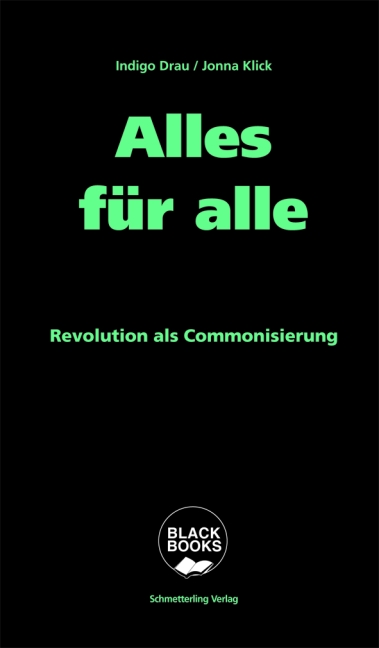
Alles für alle – bei FutureHistories

Das Buch „Alles für alle. Revolution als Commonisierung“ ist erschienen, und Indigo und Jonna waren zu Gast beim Podcast FutureHistories.

Sie sprechen darüber, was es bedeutet, Revolution nicht als Eroberung der Macht, sondern als Commonisierung der Welt zu begreifen.

Kontakt zu den Autorinnen z.B. wegen Veranstaltungen: alles-fuer-alle@riseup.net

Planning in Montpellier

EN (DE below) In this short article I would like to describe my impressions of the sub-conference “Planning, democracy and postcapitalism” as part of the annual conference of the French Association for Political Economy (Association française d’économie politique). I was invited to present a money/value/exchange-critical view. Here are the slides of my presentation (audio will hopefully follow…).

(mehr …)

Planning of societal re/production in a commonist society

Presentation online on 15 March 2024. Download the presentation slides (PDF) and the audio recording (MP3).

Update: On 20 March 2024 Simon and Stefan gave a double talk on “The Case for Commonism” and “Distributed Commonist Planning”. Here is the video recording:

(mehr …)

Simulation des Commonismus (2)

Zweiter Teil des Interviews von Jan Groos vom Podcast FutureHistories mit Manuel Scholz-Wäckerle und mir zum Projekt „Die Gesellschaft nach dem Geld“. Hier die erste Folge.