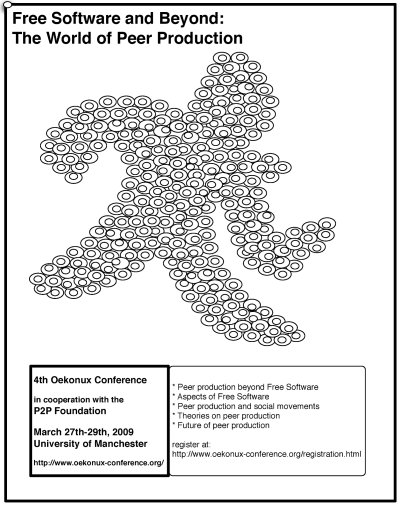
 Download the poster.
Print it, spread it!
Join the conference!
Im ersten Teil dieser Serie habe ich behauptet, dass sich die Struktur der Öffentlichkeit nicht nur generell von Massenmedien hin zu Netzmedien wandelt sondern auch innerhalb der Netzmedien ein Wandel stattfindet von einem Öffentlichkeitsmodus der Diskussion zu einem der Inspiration. Das hat die Frage aufgeworfen, wie denn in diesem neuen Modus der Öffentlichkeit das Verhältnis von Öffentlichkeit und Privatheit sei. Auch hier will ich zunächst wieder alle vier Modi der Öffentlichkeit auf diese Frage hin untersuchen:
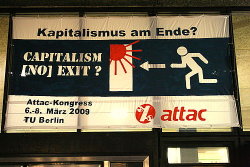 Am letzten Sonntag, 8. März 2009, begaben sich ca. 50 Interessierte auf die »Suche nach dem Neuen im Alten« — so der Titel des Attac-Workshops, zu dem Benni und ich eingeladen hatten. Es wurden kurzweilige 90 Minuten. Der komplette Audio-Mitschnitt ist bei archive.org verfügbar.
 Version 1.0 of the 4th Oekonux Conference program has been released. 26 speakers cover a wide range of topics from immaterial to material peer production and theory to practice. As far as titles of the speeches are given — a very interesting program!
The 4th Oekonux Conference is organized by Oekonux project in cooperation with P2P Foundation and takes place in Manchester (UK) from 27th to 29th of march 2009. Conference organizers ask for registration, which would help to prepare the conference.
 This post resulted from a thread on the p2presearch mailing list. The discussion started when a remark by Joseph Jackson’s “forced” me to clear up some frequent misunderstandings about the meaning of the labor theory of value, as formulated by Karl Marx. The thread then turned to Marx’ criticism of capitalism and I tried to explain why (according to Marx) the root cause of raising inequality and other detrimental effects of capitalism isn’t “unequal exchange,” but rather exchange per se, regardless of whether or not it’s equal.
Quotes from Joseph Jackson are indented and printed in italics:
Economics has no coherent Theory of Value and we must solve this problem if we are to establish the field of Abundance. The Labor Theory of Value has advantages in that it is objective and normative—it states that price should tend toward the cost of production; it also allows us to determine what constitutes equitable exchange.
Actually, the Labor Theory of Value, as first formulated by Adam Smith and Ricardo and later refined by Marx, is not normative, but descriptive: it describes the basics of price formation in capitalism. Of course, the value of goods is only their average price—actual prices will usually be somewhat below or above the average because of fluctuations in supply and demand etc.
DE: Über die GEMA-Aktion von Johannes Kreidler vom September 2008 ist nun ein Doku-Video erschienen. Die Forderungen waren zahm, aber die GEMA blieb dogmatisch. Nur im Kommunikationsstil hat sie sich an der Aktion orientiert: »Tolle Aktion hat eine tolle Diskussion angestoßen«. Und nu?
EN: There was a video documentation released about a protest against GEMA in september 2008 (a german performance rights organization). The demands were tame, but GEMA remains dogmatic. Only concerning the style of communication GEMA oriented at this action: »Great perfomance has initiated a great discussion«. And now?
[via]
A new idea comes to the US — everything for free. This is an art project, and there are nice reactions of the »takers«.
 Am 28.3. sollen große Demonstrationen in Frankfurt und Berlin unter dem Motto „Wir zahlen nicht für eure Krise“ deutlich machen, dass wir uns nicht die Kosten der Krisenbewältigung aufhalsen lassen. Damit das funktioniert, müssen da richtig viele Leute kommen, also sowas mit vielen Nullen. Das wird wohl wahrscheinlich nix werden, wenn man die bisherige Friedhofsruhe zum Maßstab nimmt. Trotzdem werde ich hingehen. Nicht, weil ich denke, dass eine mehr oder weniger dolle Regulationspolitik am Krisenverlauf als solchen viel wird ändern können. Aber weil ich tatsächlich glaube, dass es davon abhängt, wie viele Leute sich wehren, wer die Kosten aufgebrummt kriegt. Oder auch um es mit plomlompom zu sagen: „Wir müssen aufpassen, dass wir unsere Zukunft nicht an die Vergangenheit verkaufen.“
A paragraph of my previous post about an article from Michel Bauwens in we_magazine lead to heavy reactions of Michel, cross-posted here and in Oekonux mailing list. Since some posts only go to the mailing list, I re-publish one of my responses here again. Here we go:
Hi Michel,
I try to answer your questions as best as I can, but I also take the freedom to question your questions, because they base on assumptions I don’t share.
 Michel Bauwens from P2P-Foundation recently published an interesting article in the new we_magazine (=>Manifesto) summing up current developments in peer production. After explaining the most important aspects of immaterial peer production he discusses the differences when coming to material production. The first expansion step into the sphere of material production is the opening of the design process.