Kategorie: Theorie

Perspektiven jenseits der Geldlogik

Vortrag und Diskussion beim Kongress Solidarische Ökonomie in Wien (22.-24.2.2013). Ich habe die Diskussionsbeiträge in die Folien zum Mitlesen hineingesetzt, weil sie akustisch nicht immer gut zu verstehen waren. In den Download-Folien sind sie nicht enthalten. Download: Folien (ODP, PDF), Audio (OGG, MP3). Am Anfang fehlt ein Stück vom Mitschnitt, deswegen die sanfte Einblendung zu Beginn. Teil 1 des Kombivortrags zur »Einführung in die Kritik der Geldlogik« von Uli Frank findet ihr unten.


Hier der Vortrag von Uli Frank: »Einführung in die Kritik der Geldlogik« (kompletter Audio-Mitschnitt, inkl. Intro und Diskussion: OGG, MP3): (mehr …)

Gesellschaft jenseits von Tausch und Geld

Video einer Podiumsdiskussion mit Alfred Fresin, Franz Nahrada und Ed Landson (Moderation: Stefan Meretz) vom 23.2.2013 beim Kongress Solidarische Ökonomie 2013. Thesen zur Vorbereitung der Veranstaltung gibt’s im TheorieKultur-Wiki. Mitschnitt von Eat Simple Food.

Veranstaltungstipp: „Commons und Globale Dörfer: Visionen für das gute Leben nach dem Kapitalismus“ mit Brigitte Kratzwald und Franz Nahrada. Eine Veranstaltung von IOPS Austria am 15. März 2013, 18.00 Uhr, Amerlinghaus (Großer Saal Erdgeschoss), Stiftgasse 8, 1070 Wien. Weitere Informationen hier.

André Gorz und die Wertkritik

Beim André-Gorz-Kongress am 15./16.2.2013 in Saarbrücken haben Franz Schandl und ich einen Kombi-Vortrag zum Thema »André Gorz und die Wertkritik. Die Aufhebung des Kapitalismus denken« gehalten. Franz Schandl untersuchte die »Antiökonomie bei André Gorz« (Audio: OGG, MP3), während ich mich dem Wissenskommunismus widmete. Hier mein Beitrag als Slidecast (Folien: PDF, ODP; Audio: OGG, MP3):

Meine Eindrücke vom Kongress

(mehr …)

The Structural Communality of the Commons

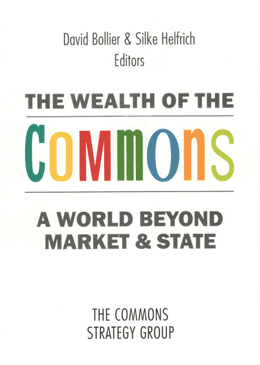
[Diesen Artikel gibt es auch auf Deutsch. Originally published in The Wealth of the Commons (eds. David Bollier and Silke Helfrich; Levellers Press, Amherst, MA, pp. 28–34). License: CC-by 3.0.]

The commons are as varied as life itself, and yet everyone involved with them shares common convictions. If we wish to understand these convictions, we must realize what commons mean in a practical sense, what their function is and always has been. That in turn includes that we concern ourselves with people. After all, commons or common goods are precisely not merely “goods,” but a social practice that generates, uses and preserves common resources and products. In other words, it is about the practice of commons, or commoning, and therefore also about us. The debate about the commons is also a debate about images of humanity. So let us take a step back and begin with the general question about living conditions.

(mehr …)

Why I Still Doubt

ZNet Debates logo[This is part of an debate regarding parecon and peercommony between Michael Albert and me. It is a repy to Michael Albert’s Peercommony Doubts Parecon? All articles can be found on the debate overview page – more will follow.]

Parecon, like capitalism, is based on paid labor, apparently based on the reasoning that people wouldn’t otherwise work enough. In my preceding reply I had doubted that assumption. When defending payment for work, you, Michael, seem to consider money as mere “information,” guiding people’s choices about how much they need to work and how much they can consume. You also seem to imagine a very impoverished model of social interaction where no other information that could influence such choices is available:

As I wrote in the original piece, “[the gap between consumption and production arises] not because people are either greedy, lazy, or irresponsible, but because people have no way to know what is responsible and moral.”

It must be a very sad society indeed where payment is the only thing that makes people “responsible and moral.” That’s not the kind of society I want.

(mehr …)

André Gorz – Kongress in Saarbrücken

André GorzAm 15. und 16. Februar 2013 im VHS-Zentrum Saarbrücken, Schlossplatz. Motto:

Der Horizont unserer Handlungen:
den Zusammenbruch des Kapitalismus denken

Der Sozialtheoretiker und Philosoph André Gorz (1923-2007) hat mit seinen Publikationen in vielen europäischen und nichteuropäischen Ländern nachhaltige Wirkungen ausgelöst. Der Kongress in Saarbrücken befasst sich mit Werk und Wirkungen.

(mehr …)

Stigmergie (von GeorgieBC)

[Deutsche Fassung des Textes Stigmergy von GeorgieBC, Lizenz CC-by-nc-sa, zur Übersetzung vgl. Anmerkung]

Stigmergy ist ein Mechanismus indirekter Koordination zwischen Beteiligten oder Aktivitäten. Das Prinzip basiert darauf, dass eine in einer Umgebung gelegte Spur die Ausführung der nächsten Aktivität anregt — durch die gleiche oder eine andere Beteiligte. Auf diese Weise tendieren die jeweils nachfolgenden Aktivitäten dazu, sich zu verstärken und aufeinander aufzubauen, was zu einer spontanen Emergenz kohärenter und offensichtlich systematischer Aktivitäten führt. Stigmergie ist eine Form der Selbstorganisation. Sie erzeugt komplexe, offensichtlich intelligente Strukturen ohne jeglichen Bedarf nach Planung, Kontrolle oder auch direkter Kommunikation zwischen den Beteiligten. — Wikipedia (en)

Ein personenbasiertes System kann ohne Repräsentation niemals eine massenhafte Zusammenarbeit im globalem Maßstab ermöglichen, wie das bei solchen Organisationen wie den Vereinten Nationen zu sehen ist. Wenn sich die Welt von Repräsentation weg bewegen und es allen Stimmen ermöglicht werden soll, gehört zu werden, dann brauchen wir ideen- und aktionsbasierte Methoden der Zusammenarbeit. Konzentrische Nutzer_innen-Gruppen bestehend aus epistemischen Gemeinschaften und Wissensbrücken könnten für ideenbasierte Systeme funktionieren; für die Aktivitäten ist Stigmergie die beste Option.

(mehr …)

Peercommony Reconsidered

ZNet Debates logo[This is part of an debate regarding parecon and peercommony between Michael Albert and me. It is a repy to Michael Albert’s Considering Peercommony. All articles can be found on the debate overview page – more will follow.]

Michael formulates various concerns and objections, many of whom are not new to me. I can’t address all of them fully, for lack of space and because many seem to ask for a blueprint of a future, non-capitalist society, which is not something I can or want to give. The meta-rule of all peer/commons-based institutions is that “you have to find your own rules.” Any successful peer project has a history of trial and error. Finding solutions that work for you is an essential part of the game.

But while I cannot describe the exact institutional mechanisms Michael asks me to describe, I’ll give my reasons why I think that people will be able to find and implement them. (mehr …)

Stigmergy

[Repost from GeorgieBC under CC-by-nc-sa, translated german version]

Stigmergy is a mechanism of indirect coordination between agents or actions. The principle is that the trace left in the environment by an action stimulates the performance of a next action, by the same or a different agent. In that way, subsequent actions tend to reinforce and build on each other, leading to the spontaneous emergence of coherent, apparently systematic activity. Stigmergy is a form of self-organization. It produces complex, seemingly intelligent structures, without need for any planning, control, or even direct communication between the agents. – Wikipedia

A personality based system can never allow for mass collaboration on a global scale without representation such as that seen in organizations like the United Nations. If the world is to move away from representation and allow all voices to be heard, we need to find methods of collaboration which work with idea and action based systems. Concentric user groups with epistemic communities and knowledge bridges may work for idea based systems; for action, stigmergy may be the best option.

(mehr …)

Die doppelten Commons

commons-dreieckDie Struktur der Commons illustriere ich gerne mit der nebenstehenden Grafik. In anderen Darstellungen geht es nicht um Commoning und Produkte, sondern das Commoning wird aufgetrennt in seine Aspekte Gemeinschaft und Regeln, während die Produkte sowie der (hier rote) rückbezügliche Pfeil zu den Ressourcen fehlen.

Ich fand die Wiederentdeckung der Fähigkeit von Gemeinschaften, sich jenseits von Markt und Staat eigenständig Regeln zu geben, immer verständlich, meinte aber auch früher schon, dass die notwendige Betonung des sozialen Aspekts nicht zu Lasten der Tatsache gehen dürfe, dass aus all dem Commoning auch immer »was heraus kommt«.

Inzwischen denke ich, dass hinter der unterschiedlichen Weise der Illustration tatsächlich eine inhaltliche Differenz steckt. Diese Differenz bezieht sich jedoch nicht auf divergente Commons-Theorien, sondern auf unterschiedliche Commons und zwar auf den realen Unterschied von alten und neuen Commons. Ausgedrückt in  Formeln sieht das so aus:

  • Alte Commons = Ressourcen + Gemeinschaft + Regeln
  • Neue Commons = Ressourcen + Commoning + Produkte

(mehr …)