Kategorie: Eigentumsfragen

The Supersession of Private Property in the Means of Production

[Part 3 of 5 of the essay »Anti-economics and Anti-politics« by Robert Kurz, published under CC by-nc-sa]

The modified or “superseded” notion of the productive forces and its connection to the relations of production is obviously the precondition for solving the real problem: the supersession of the form of fetishistic value in social relations. On this point it is also necessary, first of all, to bridge the gap between the reductive conceptions, immanent to the system, of the Marxism of the workers movement and that of the alternative movement or the cooperatives. As in the question of the productive forces, we see these movements evincing a speculative and complementary attachment to fetishistic structures. Both political Marxism and the alternative movement reduce their goal to a critique and a supersession of private property in the means of production, although in different ways. When, however, one speaks of the institution, “private property”, it is clear that one is dealing with a moment of the commodity production system, i.e., of its juridical form. It is thus clear that this moment cannot be overcome alone, without overcoming the other moments of the value form and even the latter itself as such. The attempt to eliminate private property in the means of production and at the same time to maintain the forms of mediation of the commodity and money, can only lead to social paradoxes.

(mehr …)

The Concept of the Productive Forces and the Microelectronic Revolution

[Part 2 of 5 of the essay »Anti-economics and Anti-politics« by Robert Kurz, published under CC by-nc-sa]

If we are not to allow ourselves to be confused by the past, we have to attempt to elaborate socioeconomic definitions of an embryonic form, beyond commodity production, at the current level of socialization, without falling into a vulgar practicality. It is thus not by any means a matter of direct plans of action (which can only be developed, furthermore, within the context of a social movement), but of theoretical and practical reflections to concretize the critique of value. The question of the embryonic form of a reproduction no longer mediated by monetary and commercial relations has to be approached historically, analytically and theoretically.

(mehr …)

Politics and the Question of the Embryonic Emancipatory Form

[Part 1 of 5 of the essay »Anti-economics and Anti-politics« by Robert Kurz, published under CC by-nc-sa]

The misery of the radical critique of the commodity production system, that is, of a “mode of production based on value” (Marx), appears to reside in the fact that it is incapable of representing a historical praxis (not to be confused with just any little practical activity), of taking the initiative, of finding a way out and heralding a common mass consciousness, and is thus condemned to an esoteric existence, confined to socially remote domains of purely theoretical reflection or even philosophical speculation, and ultimately to a gradual descent into an eccentric sectarian existence. Even if an emancipatory socialization eliminating fetishistic forms of the commodity and money were possible—it would still be a book sealed with seven seals for this form of critique.

(mehr …)

Anti-economics and Anti-politics

Robert Kurz (2009)[Repost from libcom.org under CC by-nc-sa]

The following translation of the German »Antiökonomie und Antipolitik« by Robert Kurz (1997) base on a Spanish translation which is no longer available on the web (the same or another Spanish version can be found here). The essay had an enormous influence on the discussion about an alternative to capitalism — not only keimform.de was one outcome of the debates initiated by this text. Kurz himself was very sceptical about the references to his text, and he often polemically dissociates himself from these references. On keimform.de we repost the text in five parts (the chapters of the text). The links below will function in the future. The following preface is from the translation at libcom.org. Here we go:

In this 1997 essay, Robert Kurz discusses the question of the “embryonic form” of “the productive forces developing in the womb of bourgeois society” (Marx); rejecting both the “all-or-nothing” view of the extreme left that sees such a project as doomed to integration into capitalism, and the reformist concept of “dual economy” where cooperative businesses produce for the capitalist market, he advocates a process of “disconnection” from the value matrix that incorporates aspects of both the old cooperative movement and modern “microelectronic” technology while preserving a commitment to overcoming the system of commodity production and a refusal to produce for the market.

Contents

1. Politics and the Question of the Embryonic Emancipatory Form

2. The Concept of the Productive Forces and the Microelectronic Revolution

3. The Supersession of Private Property in the Means of Production

4. Disconnection from Commodity Production

5. Internet Movement and Cybernetic Subversion


Gemeinsam Gemeingüter schaffen

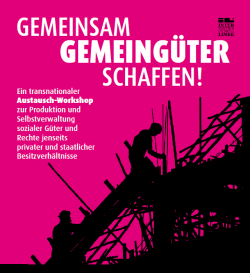
fels-commonsEin transnationaler Austausch-Workshop zur Produktion und Selbstverwaltung sozialer Güter und Rechte jenseits privater und staatlicher Besitzverhältnisse. Am Samstag, 20.04.2013, 12:00 bis 18:00 Uhr, in der Regenbogenfabrik, Lausitzer Straße 22, 10999 Berlin.

Mit Aktiven von:

  • Fundación de los Comunes (Madrid)
  • Nuovo Cinema Palazzo (Rom)
  • Alpha Kappa (Thessaloniki)
  • Projekten um demokratischen Förderalismus (Deutschland/Kurdistan)
  • FelS-Klima AG, aktiv am Berliner Energietisch (Berlin)

Aus dem Einladungstext (deutsch und englisch):

(mehr …)

Endliche Ressourcen als Gemeingut

technik_klWas wäre wenn … wir über die Nutzung von Bodenschätzen global, gemeinsam und gleichberechtigt entschieden? Einige konkrete Überlegungen wie ein Commoning rund um endliche Ressourcen aussehen könnte. Der Artikel findet sich auch im lesenswerten Büchlein “Herrschaftsfrei Wirtschaften”. Zur emanzipatorischen Technikkritik jenseits der Ressourcen-Problematik sei das Heft „Technik. Für ein gutes Leben oder für den Profit?“ empfohlen.

(mehr …)

On Private Property of Immaterial Goods

Make Copyright HistoryThe following excerpt is part of the longer essay »Free Property — On Social Criticism in the Form of a Software Licence« (PDF). It criticizes the wide-spread distinction between »natural« property of material and »artificial« restriction of immaterial goods due to private property regimes. The omitted second part, which I do not find so insightful, is about free software licences. Here’s the excerpt:

Intangible goods are different …

Indeed, at least some people within the [open-source/free-software] movement do seem to be bothered about property, at least where it specifically affects digital goods. Indeed, in terms of what they actually are, physical goods and so-called “intangible” goods differ.

(mehr …)

»Geistiges Eigentum« – nur Ideologie?

Vortrag vom 22.1.2013 in Fulda bei einer Veranstaltung des Rosa Luxemburg Clubs Vogelsberg: Die Eigentumsfrage als Frage nach der Produktionsweise stellen. Zum Herunterladen: Audio (OGG, MP3), Folien (PDF, ODP).

Linkliste (letzte Folie):

Ubuntu-Philosophie (Text)
Commons-basierte Peer-Produktion (Text)
Einschluss statt Ausschluss – Commons jenseits des Kapitalismus (Text)
Kommunismus oder Commonismus (Vortrag)
Commons als Grundlage einer neuen Produktionsweise (Vortrag)
Bedürfnisse ERmitteln oder VERmitteln? (Vortrag)
Kapitalismus aufheben – aber wie? (Vortrag)
Understanding Commons and Peer Production (Vortrag, englisch)

Tipp: »Umkämpftes Copyright«

copy-right-leftSabine Nuss hat seit längerer Zeit mal wieder einen Artikel zum »Copyriot« geschrieben. In ihrem Text »Umkämpftes Copyright. Der Streit um das geistige Eigentum« in den Blättern für deutsche und internationale Politik führt sie zunächst recht ausführlich in die Problematik ein (von ACTA bis zum Urheberrecht), um dann grundsätzlicher das »geistige Eigentum« zu diskutieren. Hier bringt sie auch ihre zentrale These:

Ganz gleichgültig, ob nun in der materiellen oder immateriellen Sphäre, in einer kapitalistisch organisierten Gesellschaft herrscht das Gesetz des Privateigentums: die „künstliche“ Verknappung ist generell notwendige Bedingung für Kapitalverwertung. (…) Die „künstliche“ Verknappung wird im materiellen Feld zumeist nicht als solche wahrgenommen, bzw. ist hier die Annahme vorherrschend, Materielles sei an sich knapp.

(mehr …)

Die Ideologie des geistigen Eigentums

Vortrag in Fulda am Dienstag, 22.1.13, 19:30 Uhr, Café Chaos, Marquardstraße, Hochschulcampus — organisiert vom Rosa Luxemburg Club Vogelsberg. Abstract:

Nicht erst durch die Piraten ist eine Frage ins Zentrum politischer Diskussionen gelangt, die noch vor einigen Jahren nur einige Handvoll Menschen in diesem Land beschäftigte: Was ist eigentlich geistiges Eigentum? Die kapitalistische Wirtschaft gründet auf dem Privateigentum und dem Vertragsrecht freier Bürger. Eine spezielle Form des Privateigentums ist das »geistige Eigentum«. Bezieht sich das »Sacheigentum« auf stoffliche, so das »geistige Eigentum« auf nichtstoffliche Güter. Ist mit der Beschaffenheit der Güter bereits der wesentliche Unterschied benannt? Ist also geistiges gleich sachliches Eigentum, oder geht der Analogieschluss fehl? Ist »geistiges Eigentum« bloß Ideologie? Und wie sind obendrein die Commons (Gemeingüter) in der komplizierten Gemengelage zu verorten? Im Vortrag gibt es keine einfachen Antworten für alle, die die »Eigentumsfrage« stellen wollen.