Kategorie: Commons

Ist die Finanzmarktkrise eine Krise der Vermittler?

Das Internet bringt jede Menge Krisen hervor, meist sind es Krisen der Vermittler. Viele von ihnen werden überflüssig oder müssen sich zumindestens massiv neue Geschäftsmodelle suchen. Die Musikindustrie ist das beliebteste Beispiel. Das Grundmuster ist immer das selbe: Das Internet bringt Anbieter und Abnehmer direkt ins Geschäft, deswegen werden die Vermittler nicht mehr benötigt.

Nun ist ja auch das Bankengeschäft im Kern ein Vermittlergeschäft. Leute mit zu viel Geld geben Leuten mit zuwenig etwas ab in der Hoffnung mehr zurückzukriegen. Dazwischen sitzen die Banken und Broker. Nun kann man schon seit ein paar Jahren von zu Hause aus Börsenhandel betreiben, und es gibt inzwischen auch viele Leute die davon leben oder es zumindestens versuchen. Außerdem gibt es Internetplattformen, die Kleinkredite vermitteln zwischen Privatleuten. Im Prinzip bräuchte also auch die Bankenvermittler niemand mehr, genau wie die Musikindustrie.

(mehr …)

Community Building in Zeiten der galoppierenden Krise

Stefan hat mich gerade dankenswerterweise durch sein letztes Posting wieder auf eine ältere Diskussion gestoßen. Ich hab dadurch meine alten Hoffnungen wieder entdeckt, die ich eigentlich mit Hiddinghausen verbunden hatte. Diese Diskussion wollte ich da eigentlich weiter führen aber dazu kam es dort nicht so recht. Ich glaube auch, dass das kein Zufall ist. Dort kamen Leute aus ganz Deutschland für ein Wochenende zusammen. Es war schon vorher klar, dass man hinterher im Alltag nicht viel miteinander zu tun haben wird. Deswegen ist es kein Wunder, dass die Schwerpunkte da andere waren. Ich möchte jetzt einen anderen Versuch starten. Worum geht es?

In einem Satz: Aufbau einer lokalen „resilient community“ zur Produktion des Lebens durch „commons based Peer Production“ in einem „Saturday House“.

Ok, jetzt seid ihr nicht viel schlauer als zuvor. Hier also ein paar Erklärungen:

(mehr …)

Why Peer Production Is Better Than Capitalism

An interview with Michel Bauwens, founder of the Peer-to-Peer Foundation:

Read the transcript of the interview here: P2P as a post-capitalist mode of production

Find more interview snippets with Michel at Peer To Peer: Social, Political, And Economic Issues In A P2P World

Hiddinghausen talks, part 3: Pooling effort where free sharing fails

In HiddinghausenMy last talk in Hiddinghausen was a little talk given as a complement to the Commons Network idea. The Commons Network is based on the idea of free and unconditional sharing—that others share with you goods they have or produce because they like to do so (and the other way around). This leaves, inevitable, the question: what if there is nobody who likes to share what you need (and you can’t produce it for yourself)? What if people need some additional incentives to produce what you would like to have?

I have already given an answer to that question in my peerconomy book: people can join an explicit agreement to help each other to produce the goods each of them likes to have, sharing the necessary effort (the tasks to do) in some pre-agreed manner. The General Luxury Production System (GLuPS) is a slightly updated version of that idea. The word “luxury” in the name is meant to express the hope that the Commons Network will become sufficiently flexible and versatile to satisfy—at least—all of people’s essential needs (the “8 Essentials” discussed in my UPset talk).

This optimistic assumption stems from the generalization of Eben Moglen’s dictum

(mehr …)

Wortsuche

Ein Blogger mit dem schönen Namen „ärgernis“ sucht ein Wort, dass folgenden Sachverhalt beschreiben soll:

Das gesuchte Wort soll einen Austausch beschreiben, der sich nicht durch quantitative Maßstäbe messen lassen kann, einer solchen Messung gar widerspricht. Durch diesen Austausch wird eine Wirkung freigesetzt, die unregelmäßigen Mustern folgt und damit wiederum ein subversives Potential entfaltet. Falls es für diese spezielle Beschreibung noch kein Begriff existiert, ist eine Wortneuschöpfung erwünscht und das Sahnehäubchen wäre der Rückgriff auf eine Sagenfigur, eine Since-Fiction-Geschichte oder aus sonst einem Bereich der hochkulturellen bis trivialen Erzählung.

Es gibt auch was zu gewinnen. (via classless)

Life Despite Capitalism – Building Radical Economies

In the beginning of November 2008, the Escanda collective along with others will be hosting a four-day radical economics gathering. We will analyse why the current economic system has failed and we will learn from the possibilities and experiences of those working despite capitalism to build autonomous networks of production and circulation from a basis of sustainability, self organization, solidarity, respect and social/environmental justice.

The gathering will focus both on the theory of radical economics and the practice: working towards creating and building radical economies within and between our own movements and collectives.

We will provide a space for networking and there will be our very own radical marketplace for participants to bring, exchange, barter and give away goods as well as services etc. [reposted]

(mehr …)

Hiddinghausen talks, part 2: A network for sharing and shared production

Discussion in HiddinghausenFree design is an important building block for spreading peer production, but it is not enough. A second topic discussed in Hiddinghausen was therefore how to facilitate and encourage the sharing and the shared production of physical goods and of services in all areas of life. My proposal here is called the Commons Network.

The Commons Network is inspired by the practices of free software and free content projects, where people do things they like to do (such as writing software or texts) and, by doing so, produce goods that are useful for others; but also by the approach of wireless community networks where the participants jointly build a free network, allowing everyone to transfer data through the free network or to access the Internet through it. Community networks are interesting because they organize the free sharing of limited resources that cannot just be copied freely (bandwidth and Internet access). And some community networks are interesting in that they’re self-organizing and self-healing: whenever nodes (participating computers) join or leave such a mesh network, it reconfigures itself to ensure that all data still finds the best route through the network.

(mehr …)

Peer-Ökonomie in Hiddinghausen – Audio-Dokumentation

Hier nun die Audio-Aufzeichnungen des Peer-Ökonomie-Wochenendes in Hiddinghausen vom 29.8. bis 31.8.2008 — siehe auch die einszweidrei kurzen Berichte dazu. Die Aufzeichnungen liegt in neun Dateien vor, wobei die Qulität der ersten sechs ganz gut ist. Die Aufnahmen sieben bis neun leiden manchmal unter Windgeräuschen. Die Downloads stehen in freien OGG- oder proprietären MP3-Format zur Verfügung:

  1. Einführung in Begriff und Konzept der Peer-Produktion: OGG (45 MB) | MP3 (44 MB)
  2. Vorstellung des Modells der Peer-Ökonomie: OGG (40 MB) | MP3 (40 MB)
  3. Diskussion des Peer-Ökonomie-Modells, Teil 1: OGG (30 MB) | MP3 (29 MB)
  4. Diskussion des Peer-Ökonomie-Modells, Teil 2: OGG (41 MB) | MP3 (40 MB)
  5. Vorstellung und Diskussion der Idee des Universal-Production-Set: OGG (32 MB) | MP3 (32 MB)
  6. Vorstellung des Konzeptes eines Commons-Netzwerkes: OGG (32 MB) | MP3 (32 MB)
  7. Diskussion des Konzeptes eines Commons-Netzwerkes: OGG (19 MB) | MP3 (18 MB)
  8. Überlegungen zur Vernetzung und Feedback-Runde: OGG (20 MB) | MP3 (20 MB)
  9. Addon im kleineren Kreis: Die Luxusgüter-Produktion: OGG (24 MB) | MP3 (23 MB)

Alle Aufzeichnungen können auch auf der Peerconomy-Seite bei archive.org als Stream angehört werden.

Hiddinghausen talks, part 1: An integrated collection of free design

Peer-Ökonomie-Wochenende in Hiddinghausen

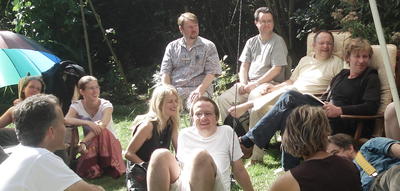
As announced in the German part of this blog, a weekend workshop on peer production and the peer economy took place during the last weekend (29-31 August) in the nice little town of Hiddinghausen in the German Ruhr Area. A detailed three-part report on the workshop, which was a fully self-organized event with about 30 participants, is available in German. The first part of the workshop was dedicated to my proposal of how to generalize the principles and practices of commons-based peer production into a full-fledged peer economy; in the second part we discussed ways of growing the range and versatility of peer production that are possible here and now. For this English-language documentation of the event, I’ll focus on this second part.

As a first initiative for facilitating the peer production of physical goods and services, I proposed to set up a „Universal Production Set“ (UPset): an integrated collection of free or open design. The goal of the UPset would be to provide designs, blueprints, and other production know-how for all areas of life, but with a a special focus on things that are essential for people to live a good life.

(mehr …)

Die dunkle Seite der Macht

Gerade haben wir uns ein ganzes langes Wochenende mit der Frage auseinandergesetzt wie man die „commons-based peer-production“ auf gesellschaftliches Niveau verallgemeinern kann. Dabei sind viele interessante Ideen entstanden und weitergedacht worden und womöglich ist das ein Fortschritt auf dem Weg zur befreiten Gesellschaft. Doch jetzt ist es Zeit sich mal wieder die dunkle Seite der Macht anzugucken. Ich nenne diese die „commons-based peer-destruction„. Diese folgt den selben Prinzipien wie ihr heller Vetter, wirkt aber nicht emanzipativ und lebendig, sondern unterdrückend und tot. Anhand zweier Beispiele möchte ich vor allem meine Ratlosigkeit demonstrieren. Gibt es irgendetwas, das diese Beispiele von peer-production, wie wir sie bisher verstanden haben, unterscheidet? Wenn ja: Was könnte das sein? Wenn nein: Ist das gut oder schlecht? Hängen diese Probleme vielleicht mit der Frage der Rolle der Gemeinschaften für die commons zusammen?

(mehr …)