
The Vienna Solidarity Economy Congress 2013 had almost a thousand visitors, and was very significant by bringing various streams of people together — people from different movements and backgrounds, gathering around the idea of cooperation and commons as the main pillars of any future economy. This is not a real mass event, but almost a must for activists and networkers in Central Europe, allowing them to forge new relations, get informed about other initiatives, bring forward their agenda. They got confronted with a plethora of offerings in two days: 120 lectures and workshops in the framework of the beautiful old Vienna University of Agriculture and in partcicular the modernist, bright Schwackhöfer building, (here some photos from 2009) plus booths, social events and so on. A great melting pot….and also a mirror of ongoing developments:
Schlagwort: geldlogik
The Structural Communality of the Commons
 [Diesen Artikel gibt es auch auf Deutsch. Originally published in The Wealth of the Commons (eds. David Bollier and Silke Helfrich; Levellers Press, Amherst, MA, pp. 28–34). License: CC-by 3.0.]
The commons are as varied as life itself, and yet everyone involved with them shares common convictions. If we wish to understand these convictions, we must realize what commons mean in a practical sense, what their function is and always has been. That in turn includes that we concern ourselves with people. After all, commons or common goods are precisely not merely “goods,” but a social practice that generates, uses and preserves common resources and products. In other words, it is about the practice of commons, or commoning, and therefore also about us. The debate about the commons is also a debate about images of humanity. So let us take a step back and begin with the general question about living conditions.
Why I Still Doubt
 [This is part of an debate regarding parecon and peercommony between Michael Albert and me. It is a repy to Michael Albert’s Peercommony Doubts Parecon? All articles can be found on the debate overview page – more will follow.]
Parecon, like capitalism, is based on paid labor, apparently based on the reasoning that people wouldn’t otherwise work enough. In my preceding reply I had doubted that assumption. When defending payment for work, you, Michael, seem to consider money as mere “information,” guiding people’s choices about how much they need to work and how much they can consume. You also seem to imagine a very impoverished model of social interaction where no other information that could influence such choices is available:
As I wrote in the original piece, “[the gap between consumption and production arises] not because people are either greedy, lazy, or irresponsible, but because people have no way to know what is responsible and moral.”
It must be a very sad society indeed where payment is the only thing that makes people “responsible and moral.” That’s not the kind of society I want.
»Reichtum ist nicht Geld, sondern ein gutes Leben zu haben«
Die Kirchenzeitung der Diözese Eisenstadt (Österreich) martinus hat mich zum bevorstehenden Kongress Solidarische Ökonomie interviewt:
Vor dem Hintergrund der derzeitigen Krisensituation wird die Frage nach Alternativen immer drängender gestellt. Zugleich gibt es immer mehr lebendige globalisierungskritische Bewegungen und eine wachsende Anzahl an Projekten gemeinschaftlicher Produktion.
Der Berliner Informatiker Stefan Meretz ist einer der Referenten am bevorstehenden Kongress „Solidarische Ökonomie“ in Wien. Im „martinus“-Interview erklärt er, wie die Idee der Solidarischen Ökonomie mit der christlichen Lehre in Zusammenhang steht.
Kongress Solidarische Ökonomie
Vom 22. bis 24. Februar 2013 findet der Solidarische Ökonomie Kongress in Wien in der Universität für Bodenkultur statt. In 100 Veranstaltungen wird eine breite Palette von Themen angeboten. Eine Gruppe von Workshop-Anbieter*innen hat sich zur Themen-Schiene »Demonetarisierung« zusammengeschlossen, an dem sich auch einige Leute von keimform.de beteiligen. Die Demonetize-Veranstalter*innen haben folgenden Text zum Kongress formuliert:
Das Verhältnis von Solidarischer Ökonomie zum Geld ist unklar. Viele Ansätze zur Veränderung der herrschenden Wirtschaftsstrukturen sehen Geld und Warentausch nach wie vor als elementare Formen wirtschaftlicher Beziehungen. Doch mehren sich die Perspektiven, die das Geld grundsätzlich kritisieren und überwinden wollen, weil es Solidarität verhindert und Herrschaftsbeziehungen fördert. Die Schiene bietet Einblick in eine Reihe von verschiedenen Zugängen zu Kritik des Geldes, seiner Voraussetzungen und Folgen. Dies schließt Ansätze ein, die eine Welt ohne Geld vorstellbar machen wollen.
Gewidmet Walther Schütz, dem unermüdlichen Aktivisten für eine Welt selbstorganisierter Kooperation / hosted by krisu und demonetize.it
Nachfolgend die Liste der Veranstaltungen aus dieser Schiene. [Aktualisiert am 19.2.2013] (mehr …)
Demonetarisierung – Der Diskurs über die Abschaffung des Geldes
[Erweiterte Ausgabe eines Artikels aus der Zeitschrift CONTRASTE. Auf dem Kongress Solidarische Ökonomie in Wien werden an die zwanzig Veranstaltungen stattfinden, die sich bewusst zur Kernthematik „eine Welt ohne Geld“ bekennen. Der folgende Artikel wurde aus diesem Anlass geschrieben.]
Es scheint, dass die Zeit der monolithischen politischen Organisationen in der antikapitalistischen Bewegung vorbei ist, dass aber dafür ein neues “organisiertes” Phänomen die Runde macht, das immer größere Bedeutung gewinnt. Es handelt sich dabei um diskurspolitische Interventionen, den Versuch, über bestimmte Begriffe Schwerpunkte in unserem Denken und Handeln zu setzen. Mindestens drei solcher diskurspolitischer Interventionen sind in den letzten Jahren entstanden: den Diskurs um die Solidarische Ökonomie, den Diskurs zu den Commons und zuletzt um das bewusste Negieren des Geldes als Vergesellschaftungsmedium, die Demonetarisierung. Daneben gibt es freilich noch die Peer-to-Peer Ökonomie, den Diskurs um Susbsistenz und Kreislaufwirtschaften (Circonomy), das Wiederentdecken der Schenkwirtschaft und vieles andere.
Peercommony Reconsidered
[This is part of an debate regarding parecon and peercommony between Michael Albert and me. It is a repy to Michael Albert’s Considering Peercommony. All articles can be found on the debate overview page – more will follow.]
Michael formulates various concerns and objections, many of whom are not new to me. I can’t address all of them fully, for lack of space and because many seem to ask for a blueprint of a future, non-capitalist society, which is not something I can or want to give. The meta-rule of all peer/commons-based institutions is that “you have to find your own rules.” Any successful peer project has a history of trial and error. Finding solutions that work for you is an essential part of the game.
But while I cannot describe the exact institutional mechanisms Michael asks me to describe, I’ll give my reasons why I think that people will be able to find and implement them. (mehr …)
Die doppelten Commons
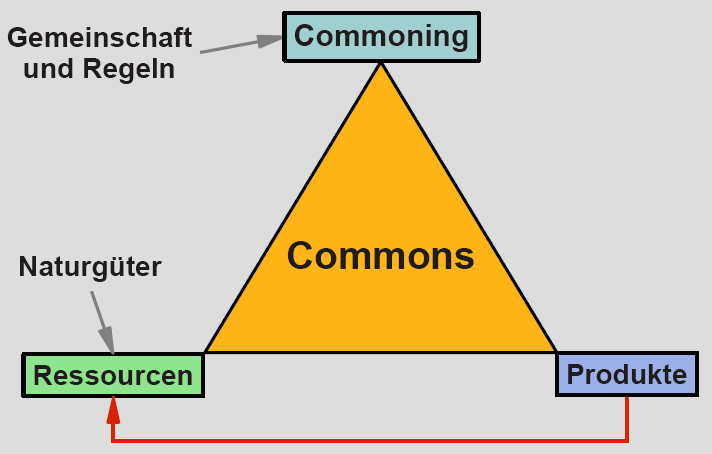 Die Struktur der Commons illustriere ich gerne mit der nebenstehenden Grafik. In anderen Darstellungen geht es nicht um Commoning und Produkte, sondern das Commoning wird aufgetrennt in seine Aspekte Gemeinschaft und Regeln, während die Produkte sowie der (hier rote) rückbezügliche Pfeil zu den Ressourcen fehlen.
Ich fand die Wiederentdeckung der Fähigkeit von Gemeinschaften, sich jenseits von Markt und Staat eigenständig Regeln zu geben, immer verständlich, meinte aber auch früher schon, dass die notwendige Betonung des sozialen Aspekts nicht zu Lasten der Tatsache gehen dürfe, dass aus all dem Commoning auch immer »was heraus kommt«.
Inzwischen denke ich, dass hinter der unterschiedlichen Weise der Illustration tatsächlich eine inhaltliche Differenz steckt. Diese Differenz bezieht sich jedoch nicht auf divergente Commons-Theorien, sondern auf unterschiedliche Commons und zwar auf den realen Unterschied von alten und neuen Commons. Ausgedrückt in Formeln sieht das so aus:
- Alte Commons = Ressourcen + Gemeinschaft + Regeln
- Neue Commons = Ressourcen + Commoning + Produkte
My Doubts About Parecon
[This is part of an debate regarding parecon and peercommony between Michael Albert and me. It is a repy to Michael Albert’s Summarizing Participatory Economics. All articles can be found on the debate overview page – more will follow.]
While I like the goals of the Parecon, one thing that confuses me is that Parecon, while intended to overcome capitalism, still resembles it in an essential aspect. Society still revolves about paid labor: everybody is forced to work for money in order to be able to buy the things they need to live. Why is that so? Do we really must forever force people to work because otherwise they wouldn’t?
A typical proponent of capitalism would probably respond: “Yes, humans are just lazy bastards. Without coercion, nobody would work and humanity would perish.” Michael Albert argues a bit smarter, but essentially in the same way:
If we disconnect work and income, … people will typically choose to work too little for the social good to be optimally met, and people will choose to take too much for the system to even work because the available output will fall well short of available demands for income.
So, everybody it still a bit too lazy and a bit too greedy for society to work without coercion, it seems. But is that claim as self-evident as Albert puts it? Moreover, if the mismatch between “available output” and “available demands” was real, could Parecon avoid it? I doubt both points.
Keimform is Going Mainstream
Federico Pistono at TEDxVienna: »Robots Will Steal Your Job, but That’s OK«
Ok, no critique of capitalism in its very notion, but on the right track. Quote:
Choose a job you love and you will never have to work a day in your live.
— Confucius