Schlagwort: transformation

ox4 Notes II: Open Hardware Challenges and Ambitions

A RonjaThis post continues my coverage of the Fourth Oekonux Conference. Johan Söderberg talked about the Czech open hardware project Ronja. RONJA was developed to provide a cheap, easily producible alternative to Wi-Fi, allowing wireless data transmission between computers. Amazingly, Ronjas use visible light for data transmission, but they are quite fast (10 MBit/s) and allow reliable point-to-point data transmissions, except in case of fog.

The goal of the Ronja project was not only to build affordable open hardware for data transmission, but also to allow the creation of anonymous, censorship-proof networks that can’t be controlled by companies or the state. All design information has been published under the GNU Free Documentation License. The Ronja hardware was sufficiently successful to be employed not only by private people, but also by companies.

(mehr …)

Notes from the Fourth Oekonux Conference I

ox4 conference logoFrom March 27th to 29th, the Fourth Oekonux Conference (announcement) took place in Manchester. It was great to meet some nice people again and to meet many nice and interesting people for the first time (in real life, that is, since I knew many participants already from virtual communications and it was a good experience to finally meet them in person).

Here are some quick notes which I wrote down during the conference sessions and polished and extended a bit afterwards.

During the first day, I didn’t took many notes, since I was busy as session helper (moderating the discussions and so on). Stefan Merten talked about Current limitations of peer production, and ideas on how to overcome them. Since Stefan doesn’t like the idea of social agreements between producers which might involve a coupling between giving and taking (as I discuss in my book), he is stuck with having to hope for technical solutions. Computers are machines for making perfect copies of digital goods, and Stefan hopes for machines can take make perfect copies of physical goods—the old Replicator dream.

(mehr …)

Workshop-Bericht: »Auf der Suche…«

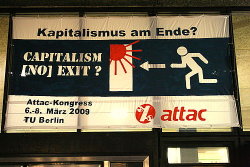
attac-kapikonAm letzten Sonntag, 8. März 2009, begaben sich ca. 50 Interessierte auf die »Suche nach dem Neuen im Alten« — so der Titel des Attac-Workshops, zu dem Benni und ich eingeladen hatten. Es wurden kurzweilige 90 Minuten. Der komplette Audio-Mitschnitt ist bei archive.org verfügbar.

(mehr …)

The question of transition and the role of money

A paragraph of my previous post about an article from Michel Bauwens in we_magazine lead to heavy reactions of Michel, cross-posted here and in Oekonux mailing list. Since some posts only go to the mailing list, I re-publish one of my responses here again. Here we go:

Hi Michel,

I try to answer your questions as best as I can, but I also take the freedom to question your questions, because they base on assumptions I don’t share.

(mehr …)

Peer-Ökonomie in der Diskussion II

Nach dem ersten Teil, dem Vortrag von Christian Siefkes, hier nun die aufbereiteten Mitschnitte des Workshops am nachfolgenden Tag. Mit 20 Teilnehmenden war die maximale Workshop-Größe ausgeschöpft. Die Diskussion war inhaltlich sehr kontrovers (»unbarmherzig«), im Ton und dem Aufeinandereingehen dennoch sehr freundlich und konstruktiv (»fortschreitend«). Zum Auftakt trug Uli Weiß eine sehr grundsätzliche Kritik am Modell der Peer-Ökonomie von Christian vor. Leider ist die Aufnahme dieses Teils misslungen 🙁

Daher gibt es nachfolgend nur die Notizvorlage von Uli, die Grundlage seines Beitrags war.

Die sich daran anschließende Diskussion wurde dann aber komplett aufgezeichnet. Ihr findet die drei Teile bei archive.org.
(mehr …)

Werner Imhof: Zur Kritik der Peer-Ökonomie II

Peer-Irrtum?Werner Imhof hat »eine ergänzende Kritik geschrieben, die sich vor allem mit Christians Methode und den „Gesellschaftlichkeitsdefiziten“ (Hubert) seines Konzepts befaßt, also einige neue Akzente und Argumente enthält« (aus einer E-Mail von Werner). Los geht’s:

Mit der Freien Software hat sich eine neuartige Form der Kooperation mit gemeinsam genutzten Produktionsmitteln entwickelt, die sich von traditionellen Formen gemeinschaftlicher Arbeit, die der Selbstversorgung im eng begrenzten familiären oder dörflichen Rahmen dienen, in mehrerer Hinsicht progressiv abhebt. Im Konzept der Peer- bzw. Peer-to-peer-Produktion hat diese Entwicklung einen theoretischen Ausdruck gefunden, der danach drängt, ihren Anwendungsbereich zu erweitern, sie womöglich gesellschaftlich zu verallgemeinern.

(mehr …)

Inclusive Democracy

DE: Das »Projekt Umfassende Demokratie« von Takis Fotopoulos von 2003 kann als Vorläufer des »Peer-Ökonomie-Modells« von Christian Siefkes gelten. Es ist erstaunlich, wieviele Ideen ähnlich sind (etwa die Ablehnung von Markt und Staat, die Belohnung der Übernahme von unbeliebten Tätigkeiten oder die nicht-repräsentationalen Räte von der lokalen bis zur globalen Ebene). Im folgenden Video erklärt Takis Fotopoulos sein Modell (deutsche Übersetzung der Untertitel hier). [Update: Deutsche Untertitel können in der schwarzen Klickliste in der unteren Menüleiste des Videos gewählt werden]

EN: The »Inclusive Democracy Project« of Takis Fotopoulos may be regarded as forerunner of the »Peer Economy Model« of Christian Siefkes. It is amazing that many ideas look similar (e.g. the rejection of markets and state, awarding of taking over unpopular efforts, or the non-representational assemblies from the local to the global level). Takis Fotopoulos is explaining his model in the following video. [Update: English subtitles can be chosen using the black drop down list in the bottom menu bar of the video]

Thanks to Libertäre Reihe

Peak-Kapitalismus

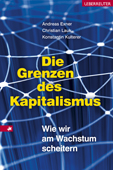
Annette Schlemm hat im Philosophenstübchen-Blog eine interessante Besprechung (Teil 1, Teil 2) über das Buch »Die Grenzen des Kapitalismus. Wie wir am Wachstum scheitern« von Andreas Exner, Christian Lauk und Konstantin Kulterer geschrieben.

Obwohl Annette die Einschätzung der Photovoltaik zu pessimistisch findet — Exner u.a. sagen, dass die Solarenergie aus stofflichen und energietischen Gründen die fossile Energietechnik nicht ablösen kann — teilt sie insgesamt die Stoßrichtung des Buches: Abschied nehmen von der Illusion, dass »bloß« eine neue politische Regulation (Reform oder Revolution) nötig ist, um die Probleme der Welt zu lösen. Auch die Suche nach Keimformen eines Neuen muss den Fokus darauf richten. Annette:

…wir können den Laden … nicht einfach übernehmen. Die Alternativen zum Kapitalismus werden sich gerade dort als überlebensfähig erweisen müssen, wo das Lebensnotwendigste fehlt. Und dies nicht unter „best case“-Bedingungen sondern im „worst case“.

ox4 Submission

ox4 conference logoHere’s my submission for the Fourth Oekonux Conference (the official deadline for submissions ended two days ago).

Title: Peer Production Everywhere

Subtitle: How Can We Do It And Where Can We Start?

Abstract:

I’ll talk about how commons-based peer production can be extended to all areas of life. How might a society based on peer production look like and which principles will be typical for such a society? I’ll also talk about which steps are reasonable to encourage the emergence of such a society.

(mehr …)

Hiddinghausen talks, part 3: Pooling effort where free sharing fails

In HiddinghausenMy last talk in Hiddinghausen was a little talk given as a complement to the Commons Network idea. The Commons Network is based on the idea of free and unconditional sharing—that others share with you goods they have or produce because they like to do so (and the other way around). This leaves, inevitable, the question: what if there is nobody who likes to share what you need (and you can’t produce it for yourself)? What if people need some additional incentives to produce what you would like to have?

I have already given an answer to that question in my peerconomy book: people can join an explicit agreement to help each other to produce the goods each of them likes to have, sharing the necessary effort (the tasks to do) in some pre-agreed manner. The General Luxury Production System (GLuPS) is a slightly updated version of that idea. The word “luxury” in the name is meant to express the hope that the Commons Network will become sufficiently flexible and versatile to satisfy—at least—all of people’s essential needs (the “8 Essentials” discussed in my UPset talk).

This optimistic assumption stems from the generalization of Eben Moglen’s dictum

(mehr …)