Schlagwort: kapitalismus

Turbokolonialismus

Es ist immer noch mal viel schlimmer, als man denkt: In dem Artikel über den Kauf von halb Madagaskar durch Daewoo im CommonsBlog wird am Ende auf den GRAIN-Report verwiesen. Darin geht es um eine »Art von neuem Landraub«. In der Tat. Klaus Pedersen, Autor des Buches »Naturschutz und Profit«, hat in der »jungen Welt« von heute das Thema unter der Überschrift »Turbokolonialismus« aufgegriffen:

Wegen der zunehmenden Erderwärmung kaufen oder pachten Regierungen Agrargebiete in ärmeren Ländern zur Absicherung der Ernährungsbasis. Unternehmen machen einen Spekulationsmarkt daraus

Hier verbindet sich also Klima- und Ökonomiekatastrophe. Die Vorbereitung für den Krieg um die Nahrungsmittelgrundlagen und für die nächste Spekulationsblase läuft heute, die Commons werden enteignet.


How does social change happen?

Great talk of Michel Bauwens at pixelACHE festival 2009, taking place from 2nd to 5th of April in Helsinki. He discusses traditional socialist theory and compares it with his P2P-approach of change giving a fairly good analysis.

As a conclusion he describes his vision in two scenarios: The so called »high road« is a hope of implementing a kind of a green capitalism adopting mechanisms of peer production, leaded und supported by the Obama administration. The second »low road« scenario is a rather dark one assuming that there will be no change from top down and all change only comes from bottom up, which implies that during the decline of capitalism these grassroot initiatives are predominantly »resilient communities« securing their immediate means of live.

Alternative Economy Cultures PART 2 from pixelACHE festival.

ox4 Notes II: Open Hardware Challenges and Ambitions

A RonjaThis post continues my coverage of the Fourth Oekonux Conference. Johan Söderberg talked about the Czech open hardware project Ronja. RONJA was developed to provide a cheap, easily producible alternative to Wi-Fi, allowing wireless data transmission between computers. Amazingly, Ronjas use visible light for data transmission, but they are quite fast (10 MBit/s) and allow reliable point-to-point data transmissions, except in case of fog.

The goal of the Ronja project was not only to build affordable open hardware for data transmission, but also to allow the creation of anonymous, censorship-proof networks that can’t be controlled by companies or the state. All design information has been published under the GNU Free Documentation License. The Ronja hardware was sufficiently successful to be employed not only by private people, but also by companies.

(mehr …)

Klimawandel: Die 3 erfolgreichsten viralen Videos

[Argh, wir müssen uns bei dir entschuldigen, Nadine, wir waren so vertrieft und haben deinen Artikel in der Warteschlange übersehen 🙁 Gerne mehr davon und am besten eine Aufwach-Mail an einen von uns schicken]

Ergänzend zum Artikel von Benni (Quelle: [1]) hier die 5 Klimawandel Videos, die im Netz die Runde gemacht haben („viraler Effekt“). Viel Spaß!
(mehr …)

Manifest zur Wiedergewinnung der Gemeingüter

forum social mundial[Via CommonsBlog. English version]

Das Weltsozialforum 2009 in Belém do Pará, Brasilien, hat das nachfolgend dokumentierte Manifest beschlossen. Es soll Grundlage für eine globale Kampagne zur Verteidigung und Wiederaneignung der Gemeingüter werden. Die Unterzeichner des Aufrufs schlagen vor, folgende Plattformen zur Mitarbeit und Diskussion zu nutzen. benscomuns.org, bienscommuns.org, bienescomunes.org, commons-campaign.org, gemeingueter.org. Hier nun das …

Manifest (mehr …)

Workshop-Bericht: »Auf der Suche…«

attac-kapikonAm letzten Sonntag, 8. März 2009, begaben sich ca. 50 Interessierte auf die »Suche nach dem Neuen im Alten« — so der Titel des Attac-Workshops, zu dem Benni und ich eingeladen hatten. Es wurden kurzweilige 90 Minuten. Der komplette Audio-Mitschnitt ist bei archive.org verfügbar.

(mehr …)

Marx’ Theory of Value and Why Exchange Can Be “Equal” and Still Bad

Karl MarxThis post resulted from a thread on the p2presearch mailing list. The discussion started when a remark by Joseph Jackson’s “forced” me to clear up some frequent misunderstandings about the meaning of the labor theory of value, as formulated by Karl Marx. The thread then turned to Marx’ criticism of capitalism and I tried to explain why (according to Marx) the root cause of raising inequality and other detrimental effects of capitalism isn’t “unequal exchange,” but rather exchange per se, regardless of whether or not it’s equal.

Quotes from Joseph Jackson are indented and printed in italics:

Economics has no coherent Theory of Value and we must solve this problem if we are to establish the field of Abundance. The Labor Theory of Value has advantages in that it is objective and normative—it states that price should tend toward the cost of production; it also allows us to determine what constitutes equitable exchange.

Actually, the Labor Theory of Value, as first formulated by Adam Smith and Ricardo and later refined by Marx, is not normative, but descriptive: it describes the basics of price formation in capitalism. Of course, the value of goods is only their average price—actual prices will usually be somewhat below or above the average because of fluctuations in supply and demand etc.

(mehr …)

The question of transition and the role of money

A paragraph of my previous post about an article from Michel Bauwens in we_magazine lead to heavy reactions of Michel, cross-posted here and in Oekonux mailing list. Since some posts only go to the mailing list, I re-publish one of my responses here again. Here we go:

Hi Michel,

I try to answer your questions as best as I can, but I also take the freedom to question your questions, because they base on assumptions I don’t share.

(mehr …)

Keimform-Seminar auf dem Attac-Kapitalismuskongress

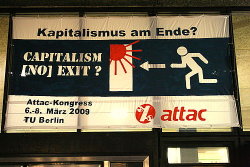
Stefan Meretz und ich machen auf dem Kapitalismuskongress von Attac (6.-8.3.2009 an der TU in Berlin) ein Seminar über die Themen, die wir hier im Blog verhandeln. Vielleicht habt ihr ja eine Idee, was ihr da gerne besprechen wollen würdet? Oder wie wir in der knappen Zeit eine sinnvolle Inspirationsquelle sein können ohne nur Vorträge zu halten? Dann in die Kommentare damit.

Werner Imhof: Zur Kritik der Peer-Ökonomie II

Peer-Irrtum?Werner Imhof hat »eine ergänzende Kritik geschrieben, die sich vor allem mit Christians Methode und den „Gesellschaftlichkeitsdefiziten“ (Hubert) seines Konzepts befaßt, also einige neue Akzente und Argumente enthält« (aus einer E-Mail von Werner). Los geht’s:

Mit der Freien Software hat sich eine neuartige Form der Kooperation mit gemeinsam genutzten Produktionsmitteln entwickelt, die sich von traditionellen Formen gemeinschaftlicher Arbeit, die der Selbstversorgung im eng begrenzten familiären oder dörflichen Rahmen dienen, in mehrerer Hinsicht progressiv abhebt. Im Konzept der Peer- bzw. Peer-to-peer-Produktion hat diese Entwicklung einen theoretischen Ausdruck gefunden, der danach drängt, ihren Anwendungsbereich zu erweitern, sie womöglich gesellschaftlich zu verallgemeinern.

(mehr …)