Kategorie: English

Not a Free Supermarket

ZNet Debates logo[This is my final reply in the debate regarding parecon and peercommony between Michael Albert and me. I wrote it in response to Michael Albert’s Replying to Siefkes Reconsideration. All articles, including Michael’s concluding statement, Lost Opportunity, can be found on the debate overview page.]

Balance and Influence

Michael, you argue that “job complexes” must be carefully “balanced” per exact rules, since otherwise people will have different degrees of influence over the decisions made at their workplace:

But suppose the workplace has a corporate division of labor. I claim that in this case too, we who work there will not all have a fair share of influence.

That may or may not be true, but so what? (mehr …)

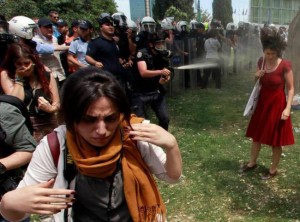
What is Happenning in Istanbul?

tear-gas-reutersReblogged: To my friends who live outside of Turkey:

I am writing to let you know what is going on in Istanbul for the last five days. I personally have to write this because most of the media sources are shut down by the government and the word of mouth and the internet are the only ways left for us to explain ourselves and call for help and support.

Four days ago a group of people most of whom did not belong to any specific organization or ideology got together in Istanbul’s Gezi Park. Among them there were many of my friends and students.  Their reason was simple: To prevent and protest the upcoming demolishing of the park for the sake of building yet another shopping mall at very center of the city. There are numerous shopping malls in Istanbul, at least one in every neighborhood! The tearing down of the trees was supposed to begin early Thursday morning. People went to the park with their blankets, books and children. They put their tents down and spent the night under the trees.  Early in the morning when the bulldozers started to pull the hundred-year-old trees out of the ground, they stood up against them to stop the operation.

(mehr …)

Reciprocity and Stigmergy

Ecc2013-logo

During the Economics and the Commons Conference I gave a seven minute talk in the labor stream with title »Direct reciprocity versus indirect reciprocity and stigmergic polycentrism as new phenomena of socialized, needs oriented production processes«. Wow. Since this title was given to me and seems to be quite complex, I approached the topic by clarifying the notions within that title. Here is my notepad, the talk was given freely, and below you’ll find some additional remarks.

(mehr …)

Economics and the Commons?!

Silke Helfrich gave an important introductory talk on the Economics and the Commons Conference (May 22 – 24, 2013, Berlin). The presentation reflects the progress of self-understanding of the commons movement. After some remarks by the moderator Armin Medosch the talk starts around 5:00 showing some commons projects illustrating the variety of the commons. At 21:30 Silke enters the more conceptual part discussing what all the different approaches have in common. The presentation ends at 54:00 and is followed by a discussion. Below, I summarize some of the conceptual statements.

These are some theses Silke developed in her talk (without discussing them here): (mehr …)

Internet Movement and Cybernetic Subversion

[Part 5 of 5 of the essay »Anti-economics and Anti-politics« by Robert Kurz, published under CC by-nc-sa]

One would have to be pretty naïve to assume that a new social movement, under the impact of the crisis, would immediately commence with a radical critique of the commodity production system. It is, rather, more likely that such a perspective can only be mediated by a public debate and by conceptual discussions in the midst of the social struggles and conflicts themselves. One does not start from zero, however. In societies in crisis, there are diverse initiatives for a “cheap economy” which, however, are still in the infant stage. These hardly do justice to a kind of reproduction “that transcends the market and the State”, since in most cases they rely on State (municipal) subsidies or else are restricted to creating enterprises based on the most basic developmental forms of the market and the State.

(mehr …)

Disconnection from Commodity Production

[Part 4 of 5 of the essay »Anti-economics and Anti-politics« by Robert Kurz, published under CC by-nc-sa]

So how is a “natural microelectronic economy” possible as an embryonic form? The difficulty consists in the fact that the capitalist form of the functional division of society, as in the case of the capitalist structure of use value, cannot be assimilated, without alterations, into an emancipatory reproduction. The personnel of an enterprise which, for example, produces ships, cannot emancipate themselves, such as they are, from the social form of value. Since they do not consume the ships and cannot satisfy their own needs with the means of production of their enterprise, and since, at the same time, the specific production of their enterprise is incorporated into a capitalist system of division of labor, they remain dependent on the production of commodities, with all the familiar social consequences.

(mehr …)

The Supersession of Private Property in the Means of Production

[Part 3 of 5 of the essay »Anti-economics and Anti-politics« by Robert Kurz, published under CC by-nc-sa]

The modified or “superseded” notion of the productive forces and its connection to the relations of production is obviously the precondition for solving the real problem: the supersession of the form of fetishistic value in social relations. On this point it is also necessary, first of all, to bridge the gap between the reductive conceptions, immanent to the system, of the Marxism of the workers movement and that of the alternative movement or the cooperatives. As in the question of the productive forces, we see these movements evincing a speculative and complementary attachment to fetishistic structures. Both political Marxism and the alternative movement reduce their goal to a critique and a supersession of private property in the means of production, although in different ways. When, however, one speaks of the institution, “private property”, it is clear that one is dealing with a moment of the commodity production system, i.e., of its juridical form. It is thus clear that this moment cannot be overcome alone, without overcoming the other moments of the value form and even the latter itself as such. The attempt to eliminate private property in the means of production and at the same time to maintain the forms of mediation of the commodity and money, can only lead to social paradoxes.

(mehr …)

The Concept of the Productive Forces and the Microelectronic Revolution

[Part 2 of 5 of the essay »Anti-economics and Anti-politics« by Robert Kurz, published under CC by-nc-sa]

If we are not to allow ourselves to be confused by the past, we have to attempt to elaborate socioeconomic definitions of an embryonic form, beyond commodity production, at the current level of socialization, without falling into a vulgar practicality. It is thus not by any means a matter of direct plans of action (which can only be developed, furthermore, within the context of a social movement), but of theoretical and practical reflections to concretize the critique of value. The question of the embryonic form of a reproduction no longer mediated by monetary and commercial relations has to be approached historically, analytically and theoretically.

(mehr …)

Politics and the Question of the Embryonic Emancipatory Form

[Part 1 of 5 of the essay »Anti-economics and Anti-politics« by Robert Kurz, published under CC by-nc-sa]

The misery of the radical critique of the commodity production system, that is, of a “mode of production based on value” (Marx), appears to reside in the fact that it is incapable of representing a historical praxis (not to be confused with just any little practical activity), of taking the initiative, of finding a way out and heralding a common mass consciousness, and is thus condemned to an esoteric existence, confined to socially remote domains of purely theoretical reflection or even philosophical speculation, and ultimately to a gradual descent into an eccentric sectarian existence. Even if an emancipatory socialization eliminating fetishistic forms of the commodity and money were possible—it would still be a book sealed with seven seals for this form of critique.

(mehr …)

Anti-economics and Anti-politics

Robert Kurz (2009)[Repost from libcom.org under CC by-nc-sa]

The following translation of the German »Antiökonomie und Antipolitik« by Robert Kurz (1997) base on a Spanish translation which is no longer available on the web (the same or another Spanish version can be found here). The essay had an enormous influence on the discussion about an alternative to capitalism — not only keimform.de was one outcome of the debates initiated by this text. Kurz himself was very sceptical about the references to his text, and he often polemically dissociates himself from these references. On keimform.de we repost the text in five parts (the chapters of the text). The links below will function in the future. The following preface is from the translation at libcom.org. Here we go:

In this 1997 essay, Robert Kurz discusses the question of the “embryonic form” of “the productive forces developing in the womb of bourgeois society” (Marx); rejecting both the “all-or-nothing” view of the extreme left that sees such a project as doomed to integration into capitalism, and the reformist concept of “dual economy” where cooperative businesses produce for the capitalist market, he advocates a process of “disconnection” from the value matrix that incorporates aspects of both the old cooperative movement and modern “microelectronic” technology while preserving a commitment to overcoming the system of commodity production and a refusal to produce for the market.

Contents

1. Politics and the Question of the Embryonic Emancipatory Form

2. The Concept of the Productive Forces and the Microelectronic Revolution

3. The Supersession of Private Property in the Means of Production

4. Disconnection from Commodity Production

5. Internet Movement and Cybernetic Subversion