Yeah, nice often-quoted scene from Star Trek.
Kategorie: English
Open Materials
Catarina Mota ist Sozialwissenschaftlerin und bezeichnet sich als »Maker«. Sie ist Mitgründerin von openMaterials und Ko-Vorsitzende der Open Source Hardware Association (Vortrag in Englisch mit deutschen Untertiteln).
Commons-based Society as a Thought Experiment
In preparation of the Commons Economics Conference which will be held in Berlin on May 22-24, there have been three „Deep Dive Workshops“ around the world (Bangkok, Mexico City, Paris). I had the opportunity to participate in the European Meeting in Pontoise near Paris. David Bollier generously wrote an interpretative summary based on notes from a pirate pad, which was collectively used by the participants. In his blog he published some excerpts from the lengthy paper which seem interesting to him. During the workshop I did a Though Experiment on how a commons-based society could function. Here is the respective part taken from the summery:
Stefan Meretz’s Thought Experiment
Vienna Solidarity Economy Congress 2013 – interesting outcomes of demonetization track

The Vienna Solidarity Economy Congress 2013 had almost a thousand visitors, and was very significant by bringing various streams of people together — people from different movements and backgrounds, gathering around the idea of cooperation and commons as the main pillars of any future economy. This is not a real mass event, but almost a must for activists and networkers in Central Europe, allowing them to forge new relations, get informed about other initiatives, bring forward their agenda. They got confronted with a plethora of offerings in two days: 120 lectures and workshops in the framework of the beautiful old Vienna University of Agriculture and in partcicular the modernist, bright Schwackhöfer building, (here some photos from 2009) plus booths, social events and so on. A great melting pot….and also a mirror of ongoing developments:
The Structural Communality of the Commons
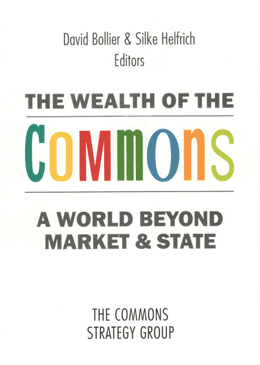
[Diesen Artikel gibt es auch auf Deutsch. Originally published in The Wealth of the Commons (eds. David Bollier and Silke Helfrich; Levellers Press, Amherst, MA, pp. 28–34). License: CC-by 3.0.]
The commons are as varied as life itself, and yet everyone involved with them shares common convictions. If we wish to understand these convictions, we must realize what commons mean in a practical sense, what their function is and always has been. That in turn includes that we concern ourselves with people. After all, commons or common goods are precisely not merely “goods,” but a social practice that generates, uses and preserves common resources and products. In other words, it is about the practice of commons, or commoning, and therefore also about us. The debate about the commons is also a debate about images of humanity. So let us take a step back and begin with the general question about living conditions.
Why I Still Doubt
[This is part of an debate regarding parecon and peercommony between Michael Albert and me. It is a repy to Michael Albert’s Peercommony Doubts Parecon? All articles can be found on the debate overview page – more will follow.]
Parecon, like capitalism, is based on paid labor, apparently based on the reasoning that people wouldn’t otherwise work enough. In my preceding reply I had doubted that assumption. When defending payment for work, you, Michael, seem to consider money as mere “information,” guiding people’s choices about how much they need to work and how much they can consume. You also seem to imagine a very impoverished model of social interaction where no other information that could influence such choices is available:
As I wrote in the original piece, “[the gap between consumption and production arises] not because people are either greedy, lazy, or irresponsible, but because people have no way to know what is responsible and moral.”
It must be a very sad society indeed where payment is the only thing that makes people “responsible and moral.” That’s not the kind of society I want.
On Private Property of Immaterial Goods
The following excerpt is part of the longer essay »Free Property — On Social Criticism in the Form of a Software Licence« (PDF). It criticizes the wide-spread distinction between »natural« property of material and »artificial« restriction of immaterial goods due to private property regimes. The omitted second part, which I do not find so insightful, is about free software licences. Here’s the excerpt:
Intangible goods are different …
Indeed, at least some people within the [open-source/free-software] movement do seem to be bothered about property, at least where it specifically affects digital goods. Indeed, in terms of what they actually are, physical goods and so-called “intangible” goods differ.
The Pirate Bay – Away From Keyboard
DE: Der Film TPB AFK von Simon Klose hatte bei der Berlinale Offline-Premiere. Im Mittelpunkt stehen die zahlreichen Prozesse gegen die TPB-Gründer. Bevor ihr euch den Film anseht (englische Untertitel), lest die Sicht von Peter Sunde dazu. Er beklagt den zu dunklen Grundton des Films und betont demgegenüber Spaß, Freundschaft und weltweite Unterstützung.
EN: The movie TPB AFK from Simon Klose had its offline premiere at Berlinale Festival. Numerous trials against the TPB-founders are in the center of the film. Before watching the movie (english subtitles), I recommend reading the view of Peter Sunde. He complains about the dark undertone the film has and, in contrast, underlines fun, friendship and worldwide support.
Open Source Ecology Philosophy
On how to create material abundance with a two-hour day of working.
Peercommony Reconsidered
[This is part of an debate regarding parecon and peercommony between Michael Albert and me. It is a repy to Michael Albert’s Considering Peercommony. All articles can be found on the debate overview page – more will follow.]
Michael formulates various concerns and objections, many of whom are not new to me. I can’t address all of them fully, for lack of space and because many seem to ask for a blueprint of a future, non-capitalist society, which is not something I can or want to give. The meta-rule of all peer/commons-based institutions is that “you have to find your own rules.” Any successful peer project has a history of trial and error. Finding solutions that work for you is an essential part of the game.
But while I cannot describe the exact institutional mechanisms Michael asks me to describe, I’ll give my reasons why I think that people will be able to find and implement them. (mehr …)