Kategorie: English

Dedicated to 1st of may: Do we need to »work«?

There is an interesting debates in the oekonux mailinglist about work, market, money and exchange. I cut out some snippets and re-post them here. It is from a discussion between Diego Saravia from Argentina and me, which starts from the question if (the today existence of) money coerces people to work.

Diego wrote:

money is not the reason for coercion, is only a mechanism

the logic of coercion is far more profound than money

(mehr …)

How does social change happen?

Great talk of Michel Bauwens at pixelACHE festival 2009, taking place from 2nd to 5th of April in Helsinki. He discusses traditional socialist theory and compares it with his P2P-approach of change giving a fairly good analysis.

As a conclusion he describes his vision in two scenarios: The so called »high road« is a hope of implementing a kind of a green capitalism adopting mechanisms of peer production, leaded und supported by the Obama administration. The second »low road« scenario is a rather dark one assuming that there will be no change from top down and all change only comes from bottom up, which implies that during the decline of capitalism these grassroot initiatives are predominantly »resilient communities« securing their immediate means of live.

Alternative Economy Cultures PART 2 from pixelACHE festival.

The Meaning of the Commons

[Update: Im CommonsBlog gibt es eine deutsche Übersetzung der wesentlichen Teile des Vortrags]

Great opening talk by Law Prof. Louis Wolcher on a one day conference »The Law of the Commons« organized by the Seattle Chapter of the National Lawyers Guild Friday, March 13, 2009. He is speaking about the forgotten tradition of commoning as a social practice of people taking their lives in their own hands [via].

ox4 Notes II: Open Hardware Challenges and Ambitions

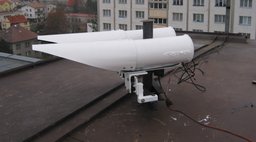
A RonjaThis post continues my coverage of the Fourth Oekonux Conference. Johan Söderberg talked about the Czech open hardware project Ronja. RONJA was developed to provide a cheap, easily producible alternative to Wi-Fi, allowing wireless data transmission between computers. Amazingly, Ronjas use visible light for data transmission, but they are quite fast (10 MBit/s) and allow reliable point-to-point data transmissions, except in case of fog.

The goal of the Ronja project was not only to build affordable open hardware for data transmission, but also to allow the creation of anonymous, censorship-proof networks that can’t be controlled by companies or the state. All design information has been published under the GNU Free Documentation License. The Ronja hardware was sufficiently successful to be employed not only by private people, but also by companies.

(mehr …)

Notes from the Fourth Oekonux Conference I

ox4 conference logoFrom March 27th to 29th, the Fourth Oekonux Conference (announcement) took place in Manchester. It was great to meet some nice people again and to meet many nice and interesting people for the first time (in real life, that is, since I knew many participants already from virtual communications and it was a good experience to finally meet them in person).

Here are some quick notes which I wrote down during the conference sessions and polished and extended a bit afterwards.

During the first day, I didn’t took many notes, since I was busy as session helper (moderating the discussions and so on). Stefan Merten talked about Current limitations of peer production, and ideas on how to overcome them. Since Stefan doesn’t like the idea of social agreements between producers which might involve a coupling between giving and taking (as I discuss in my book), he is stuck with having to hope for technical solutions. Computers are machines for making perfect copies of digital goods, and Stefan hopes for machines can take make perfect copies of physical goods—the old Replicator dream.

(mehr …)

Oekonux Conference Schedule V1.0

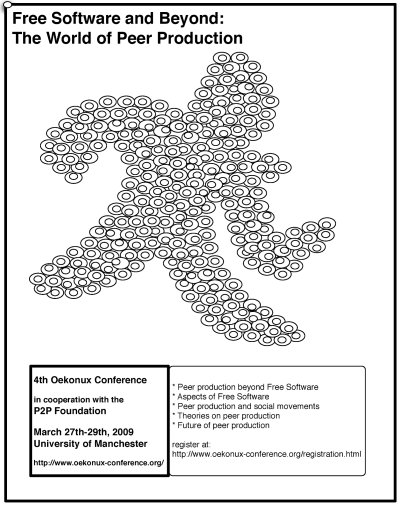
4th Oekonux ConferenceVersion 1.0 of the 4th Oekonux Conference program has been released. 26 speakers cover a wide range of topics from immaterial to material peer production and theory to practice. As far as titles of the speeches are given — a very interesting program!

The 4th Oekonux Conference is organized by Oekonux project in cooperation with P2P Foundation and takes place in Manchester (UK) from 27th to 29th of march 2009. Conference organizers ask for registration, which would help to prepare the conference.

Marx’ Theory of Value and Why Exchange Can Be “Equal” and Still Bad

Karl MarxThis post resulted from a thread on the p2presearch mailing list. The discussion started when a remark by Joseph Jackson’s “forced” me to clear up some frequent misunderstandings about the meaning of the labor theory of value, as formulated by Karl Marx. The thread then turned to Marx’ criticism of capitalism and I tried to explain why (according to Marx) the root cause of raising inequality and other detrimental effects of capitalism isn’t “unequal exchange,” but rather exchange per se, regardless of whether or not it’s equal.

Quotes from Joseph Jackson are indented and printed in italics:

Economics has no coherent Theory of Value and we must solve this problem if we are to establish the field of Abundance. The Labor Theory of Value has advantages in that it is objective and normative—it states that price should tend toward the cost of production; it also allows us to determine what constitutes equitable exchange.

Actually, the Labor Theory of Value, as first formulated by Adam Smith and Ricardo and later refined by Marx, is not normative, but descriptive: it describes the basics of price formation in capitalism. Of course, the value of goods is only their average price—actual prices will usually be somewhat below or above the average because of fluctuations in supply and demand etc.

(mehr …)

Doku über GEMA-Aktion

DE: Über die GEMA-Aktion von Johannes Kreidler vom September 2008 ist nun ein Doku-Video erschienen. Die Forderungen waren zahm, aber die GEMA blieb dogmatisch. Nur im Kommunikationsstil hat sie sich an der Aktion orientiert: »Tolle Aktion hat eine tolle Diskussion angestoßen«. Und nu?

EN: There was a video documentation released about a protest against GEMA in september 2008 (a german performance rights organization). The demands were tame, but GEMA remains dogmatic. Only concerning the style of communication GEMA oriented at this action: »Great perfomance has initiated a great discussion«. And now?

[via]