Adrian Bowyer gave a talk at FOSDEM 2010 in Brussels about RepRap, the cool GPL licenced 3D-printer which could (partly) replicate itself. Watch the talk and learn, why personal fabrication will succeed over old industrial mass production, even in its decentralized form, and why personal fabrication will succeed in the run for creativity [via].
Kategorie: English
The Earth’s the Limit (1)
The vision of post-scarcity is a popular but controversial meme in the debates of peer production. Post-scarcity envisions a world where everything is free as in free beer, where no payment or accounting is requirement for anything you use. Post-scarcity ideas usually rely very strongly on advanced technology, postulating that almost everything can be automated—or at least, everything that’s not fun and pleasant to do. Post-scarcity theorists also believe that advanced technology can provide enough natural resources and enough energy in order to satisfy everyone’s needs and wishes, possibly through extracting resources from space or through speculative future technologies such as nuclear fusion power.
A weak form of post-scarcity thinking is present in one of the founding documents of the free software movement, Richard Stallman’s GNU Manifesto (“weak” because there are still necessary tasks that are neither fun nor automated away):
Exchange, justice and injustice
In a recent post Oekonux participant Raoul Victor from France deals with the question, if it is possible to have »no commercial injustice«. Here is the main part of the post (full length here in RTF).
The problem is that the main source of „injustice“ is commerce, trade itself. For two fundamental reasons: the first is general and concerns any symmetric exchange; the second is more specific to capitalism. (mehr …)
Commons in a taxonomy of goods
Commons are common pool resources. Commons are common goods. Commons are social relationships. You can find all of these descriptions for the term. Which is the correct one? All three versions are valid—at the same time!
The word „common“ is the best starting point for the analysis. The common thing within a commons are the resources, which are used and cared for, are the goods resulting from joint activities, and are the social relationships emerging from acting together. These three aspects are so different for all commons, that no one could describe them in a reasonably complete manner.
Commons are at odds with commodities, although a commodity is a good which is produced in a specific social form using resources. But it is usual that traditional economics only consider resources as social forms of production in a marginal way or even not in any way. I will try to overcome this limitation by using the following taxonomy of goods [Illustration 1]. I decide to put the concept of „good“ into the center, while describing from the triple definition explained above: as a common good, as a resource and as a social form.
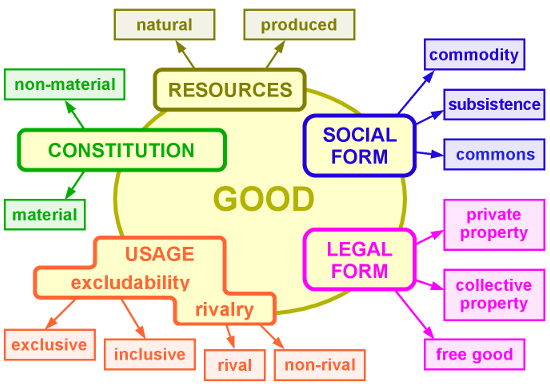
Illustration 1: Proposed taxonomy of „goods“
Manifesto »Strengthen the Commons – Now!«
 [
[The following manifesto is the result of a one and a half year process, where dozens of participants from politics, unions, sciences, the free culture and software movement, the environmental movement, economy as well as from art and culture discussed about commons and the relevance for humankind. It was developed in the context of the Interdisciplinary political salons of the Heinrich Böll Foundation‘s „Time for commons“.
Below, the entire text of the manifesto is documented, which is also available as a nicely layouted PDF (4 pages) at Commonsblog. (mehr …)
The Tricky Business of “Copylefting” Hardware
[Diesen Artikel gibt es auch auf Deutsch.]
It’s probably safe to say that the copyleft principle has been essential for the success of free software. Copyleft means that all versions of a software or document will remain free, preventing companies from creating “value-added” versions of free programs and selling them as proprietary, non-free software. The GNU General Public License (GPL)—the first and most well-known incorporation of the copyleft principle—is used for about 50–70% of all free programs, making it more popular than all other free software licenses together.
At first sight, the situation in the newly emerging field of free and open hardware might seem similar—here, copyleft licenses such as the GPL and the Creative Commons Attribution-ShareAlike License (BY-SA) are very popular too (see below for a more detailed analysis). But actually, the situation is very different for hardware design, since copyleft relies on copyright, and hardware is (in most cases) not protected by copyright law.
(mehr …)
The commons as a strategic perspective for social movements
This is a translation of a german article. Hier gibt es den Artikel in deutsch.
The power of social movements lies in their heterogeneity. Because of it, they achieve longer lasting and more fundamental change than other societal actors. But it makes them confusing, too. In addition to fighting for change, they are subject to fights themselves. From parties over NGOs to trade unions and churches, they all fight to play a role in social movements.
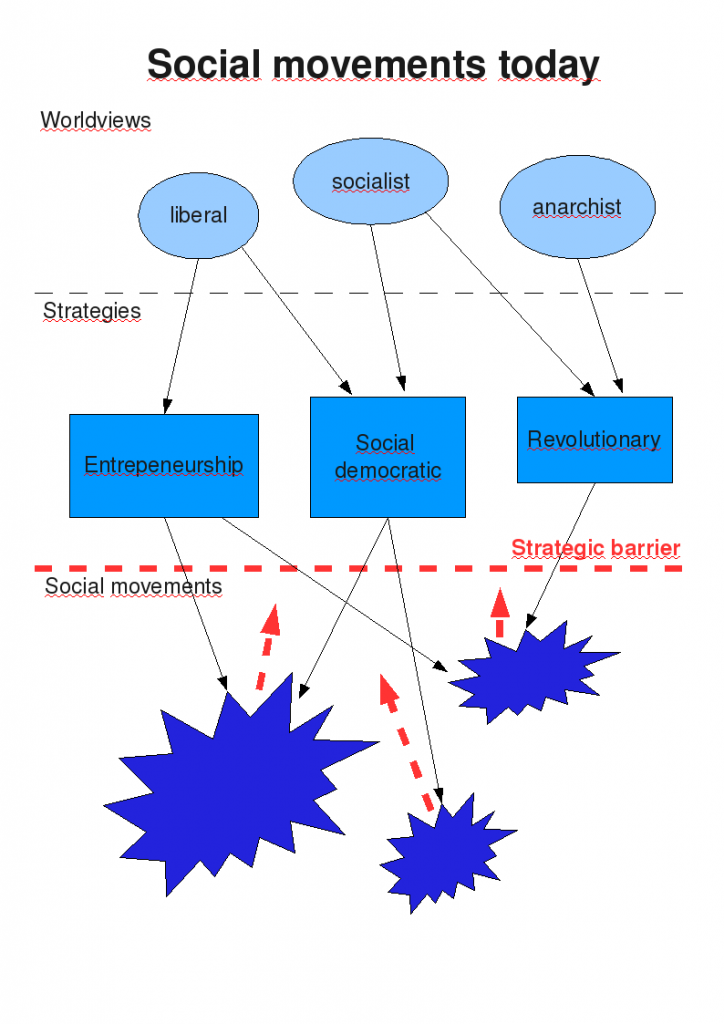 We can somewhat order this chaos by looking at the relation between worldviews, strategies and tactics of the players involved. Most often strategies are employed which match the respective worldview. For example, the social democratic strategy of seizing state power and softening the impertinences of capitalism is expression of a socialistic worldview; the strategy of demanding value based decisions is based on a conservative worldview, etc. Here, the respective notion of societal change becomes visible as well. Experience shows that communication between actors that have different worldviews is almost impossible. Across strategic borders understanding is difficult. This is one of the reasons why communication within social movements often is so exhausting.
Indidividual Needs and Societal Necessities
This is a reply which I wrote on the english list of the Oekonux project on a mail by Stefan Merten with the subject »Balancing need and Selbstentfaltung by governance?« Since this question has a fundamental meaning, I wrote a more general and philosophical answer. I made a few typo corrections on the original post.
On 2009-11-04 20:22, Stefan Merten wrote:
Recently once again I thought about the problem of balancing need and Selbstentfaltung. I think this is the fundamental question which concepts like Christian are struggling for: How is the societal need balanced with Selbstentfaltung.
From my POV „balancing“ is the wrong term to raise the problem adequately. (mehr …)
FREE BEER released

Lula praises Free Software
Brazilian President Lula da Silva gave a passionate speech about the importance of Free Software and the Internet at the 10th Free Software International Forum, in Porto Alegre, Brazil, June 26th, 2009. He is talking about the significance of Free Software for the new self-esteem of Brazil as a »new country« and about »digital inclusion« being the »most sexy word of government«.
The length of the video is 15:45 (not 20:23 as indicated, the rest ist black). [via]