Autor: Christian Siefkes

Material peer production—Part 3: Commons and Possession

Book Cover[Diesen Artikel gibt es noch nicht auf Deutsch. Wenn du dazu beitragen willst, das zu ändert, beteilige dich bitte an der Übersetzungs-Werkstatt.]

Previous part: Free Cooperation.

Peer production is based on commons and possession, not on property. As long as you use something (by yourself), there is no obvious difference between possession and property. The difference only becomes visible when you stop using it: your property still remains your property, allowing you to sell it to someone else (in return for money or some other equivalent). But possession is bound to usage—if you no longer need something, you cease possessing it and somebody else can start possessing it.

One issue where this becomes relevant is the question of long-term vs. short-term usage. When projects expect people to make contributions in order to get the things they want, there are cases where the length of usage should be taken into account. Otherwise, people who want to use something for a limited period of time would be put at a serious disadvantage, since they would have to contribute just as much as if they wanted to use it “forever.” When the expected “lifespan” of a good exceeds the expected time of usage by any given person, it might thus be appropriate to tie the required contributions to the length of usage, sharing the overall effort between all who use it over time. For example, a project or local association organizing housing for its members might prefer to require contributions for living in a house or apartment for a certain amount of time (instead of for living there forever), thus spreading the effort necessary for building and maintaining houses among all the people who live there over time.

The difference between property and possession is also relevant for the problem of resource allocation. In an economy where everything is based on commons and possession instead of property, it would not make sense to treat natural resources as property—to rely on buying and selling to allocate them. In fact, it would not even be possible: if nothing apart from resources is sold, how should those who lack them be able to buy them?
(mehr …)

Material peer production—Part 2: Free Cooperation

'From Exchange to Contributions' Cover[Diesen Artikel gibt es noch nicht auf Deutsch. Wenn du dazu beitragen willst, das zu ändert, beteilige dich bitte an der Übersetzungs-Werkstatt.]

Previous part: Effort Sharing.

Cooperation Between Projects

In the previous part, I have discussed how a project can distribute the effort required for production among those who want to benefit. With these effort sharing models, it is not necessary for participants to produce by themselves what they want to consume—if a project produces different goods (bicycles, cars, etc.), you can take part in producing a good A, and in return get access to any other good(s) B produced by the same project. This allows you to get access to various goods without having to get involved in the production of all of them.

But so far these models have only been considered in the context of a single project, which poses a problem: as consumers, people generally have many diverse needs and desires. In order to satisfy them all, you would either need a project that produces a lot of very different goods, and such a huge project might become inflexible and hard to maintain. Or you would have to contribute to lots of different projects, which would complicate your life enormously.

We can understand this problem better by regarding the different aspects which the participants of a project need to handle:

(mehr …)

Material Peer Production — Part 1: Effort Sharing

Book Cover[Es gibt eine deutsche Übersetzung dieses Artikels.]

Previous part: Traits of Peer Production.

The first characteristic of peer production is that the effort required to reach the goals of a project is shared among those who care enough to contribute. How this sharing is organized depends on the kind of project.

Projects creating free software or open knowledge use a style which Francis Heylighen [2007] describes as „stigmergic“ (hint-based). The work done in such projects leaves „stimuli“ or hints motivating others to continue. Examples of such hints are to-do lists, bug reports, and feature requests in free software projects; or „red links“ to missing articles and listings of „most wanted articles“ in the Wikipedia. They point participants and potential participants to the tasks that are worth doing.

This hinting system also serves as an informal mechanism for prioritizing tasks: the more people care for a task, the more likely it is to be picked up by somebody (since the corresponding hints tend to become more visible and explicit, and since people are more likely to pick up a task they wish to be done). And since everybody is free in choosing the tasks they want to do, participants will generally be more motivated than in a market-based system, where they have to follow the orders of their boss or customer. They also tend to pick up those tasks they think they are good at, ensuring that the different talents and skills of people are applied in the best possible way.

(mehr …)

Materielle Peer-Produktion — Teil 0: Merkmale der Peer-Produktion

Buch-Cover[This is the German translation of the original English article.]

Ist es möglich, die Peer-Produktion in die physische Welt auszuweiten und materielle Güter und Dienstleistungen auf die gleiche Weise zu produzieren wie Freie Software und offenes Wissen? Ist es möglich, dass Peer-Produktion zur primären Produktionsweise wird und damit Märkte und den Kapitalismus überflüssig macht? In meinem „Peerconomy„-Buch argumentiere ich, dass dies in der Tat möglich ist und diskutiere wie es umgesetzt werden kann. Dieser Beitrag ist der erste Teil einer kurzen Artikel-Serie, in denen die Kernideen meines Konzepts erklärt werden. Sie wurde ausgelöst durch eine Diskussion auf der englischsprachigen Oekonux-Liste. Dieser Artikel dokumentiert meine erste Mail.

(mehr …)

Material Peer Production — Part 0: Traits of Peer Production

'From Exchange to Contributions' Cover[Update: es gibt jetzt auch eine komplette deutsche Übersetzung dieses Artikels — danke, Stefan!]

Is it possible to generalize peer production into the physical world and to produce material goods and services in the same way as free software and open knowledge? Is it possible for peer production to become the primary mode of production, obsoleting markets and capitalism? In my „Peerconomy“ book, I argue that it is indeed possible and discuss how it can be done. This is the first part of a short series explaining my core ideas. It was triggered by discussion on the English Oekonux list. This article documents my first mail.

(mehr …)

Es geht ums Ganze — aber jenseits des Kapitalismus wird nicht gedacht

Bekanntlich waren Stefan, Benni und ich von Freitag bis Sonntag auf dem „No way out?“-Kongress des „…ums Ganze!“-Bündnis ins Frankfurt am Main, zu dem es hier auch schon im Vorfeld einige Diskussionen gegeben hatte. Hier meine Eindrücke.

Das Fragezeichen im Titel („No way out?“) wurde auf dem Kongress selbst gelegentlich vergessen, was durchaus symptomatisch für die Inhalte stand, wie man sehen wird. Gemäß Kongress-Untertitel sollten aktuelle kapitalismuskritische Theorien von „(Post-)Operaismus“ bis „Wertkritik“ reflektiert und auf ihre Anwendbarkeit für linke Praxis überprüft werden — tatsächlich ließen sich auch die meisten Referent/innen mehr oder weniger klar einer dieser beiden Strömungen zuordnen. Erfreulicherweise war der Kongress (anscheinend auch für die Veranstalter/innen) überraschend gut besucht, mit mehreren hundert überwiegend jungen Teilnehmer/innen, wohl hauptsächlich aus dem Antifa-Spektrum. Schön war es auch, nette Leute wie etwa Uli Frank und Juli zu treffen 🙂

(mehr …)

Das Filesharing-Epos

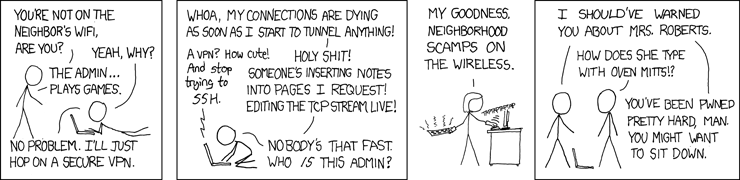
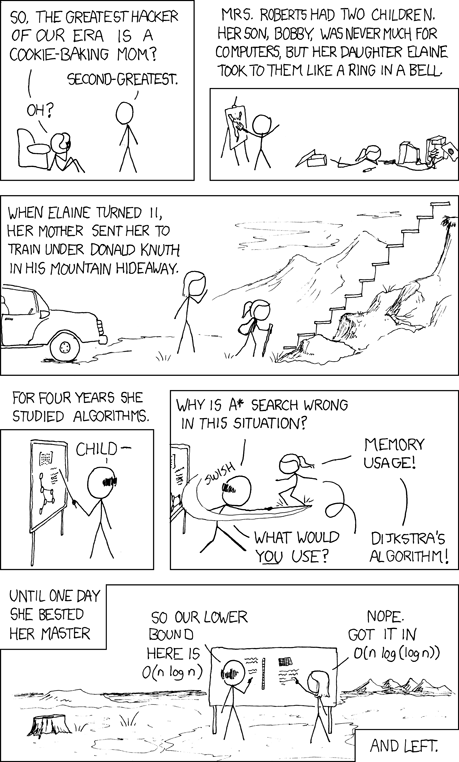
xkcd bringt ein großes Epos des digitalen Zeitalters. Donald Knuth, Richard Stallman und Cory Doctorow kommen vor — aber die eigentlichen Heldinnen sind natürlich zwei Frauen!

(Die erste und die letzte Folge sind verkleinert – auf ein Bild klicken, um es in Originalgröße zu sehen.)

1337: Part 1

1337: Part 2

(mehr …)

Creative Commons und das Quellcode-Problem

Dieser Beitrag hat mich auf ein praktisches Problem mit den Creative CommonsShareAlike-Lizenzen aufmerksam gemacht, nämlich dass sie kaum etwas dafür tun, um den Zugang zum Quellcode modifizierter Werke sicherzustellen. In der aktuellen deutschen Attribution-ShareAlike-Lizenz heißt es lediglich:

Sie dürfen eine Bearbeitung nicht mit technischen Schutzmaßnahmen versehen, die den Zugang oder den Gebrauch der Bearbeitung in einer Weise kontrollieren, die mit den Bedingungen dieser Lizenz im Widerspruch stehen. (§4b.)

DRM ist also verboten, aber ansonsten gibt es keinerlei Verpflichtung, Modifikationen in einer Weise zugänglich zu machen, die eine Weiterverbreitung oder weitere Veränderungen ermöglicht – ein „Recht auf Quellcode“ gibt es nicht. Text, der nur als PDF verbreitet wird, müsste also ggf. neu gesetzt werden (v.a. komplexe Elemente wie Formeln lassen sich aus PDFs kaum vernünftig extrahieren); gedruckte Bücher müssten eingescannt werden; Filme, die nur im Kino gezeigt werden, gar von der Leinwand abgefilmt werden – und das, obwohl sie Inhalte enthalten, die von anderen unter eine ShareAlike-Lizenz gestellt wurden und somit selbst dieser Lizenz unterliegen.

Ohne ein „Recht auf Quellcode“ bleibt der „ShareAlike“-Grundsatz leider sehr zahnlos – was nutzt ein Recht auf Modifikation, wenn man nicht auch die Möglichkeit dazu hat? IMHO ein ernstzunehmender Einwand gegen die Creative Commons-ShareAlike-Lizenzen.

Schade drum, insbesondere da die andere weit verbreitete Copyleft-Lizenz für Inhalte – die GFDL – ja auch ihre Problemen hat (v.a. macht ihre Anforderung, den kompletten Lizenztext immer mitzuliefern, sie für viele Zwecke einfach unbrauchbar). Die Design Science License, die recht knapp und elegant ist und auch von der Free Software Foundation als “free and copyleft” anerkannt wird, könnte eine Alternative sein – aber andererseits ist „Copyleft-Proliferation“ ja auch ein Übel…

Dezentralisierung wird Mainstream

Sieben Jahre, nachdem mein einstiger Chef Lucas Gonze die [Decentralization]-Mailingliste gegründet hat, in der Phänomene wie der damalige überwältigende Erfolg des ersten P2P-Filesharingsystems Napster erstmals unter dem Label „Dezentralisierung“ beschrieben und analysiert wurden, scheint dieser Begriff langsam Mainstream zu werden.

Sieht so die Wikipedia aus?Das US-amerikanische Autorenduo Ori Brafman und Rod Beckstrom hat dazu ein Buch „The Starfish and the Spider“ („Der Seestern und die Spinne“) vorgelegt, wo sie den „dezentralisierten“ Seestern der zentralisierten, hierarchischen Spinne entgegenhalten – und im „Seestern“-Modell die Zukunft sehen:

(mehr …)

Peerconomy-Buch erschienen

Es hat etwas länger gedauert als gehofft, aber meine Einführung in die Peer-Ökonomie ist jetzt auch als gedrucktes Buch verfügbar. Wer an einem Exemplar interessiert ist, kann es ab sofort im Peerconomy-Wiki bestellen. Bei Onlinebestellung kommen zu den 9,50 EUR für das Buch (156 Seiten) noch 2,50 EUR Versandkosten, die ich leider nicht vermeiden kann (die tatsächlichen Versandkosten sind noch höher). Aber das ist dieser revolutionäre Text schon wert 🙂