Autor: Christian Siefkes

ox4 Notes IV: Case Study of a Large Free Software Project

The BSD daemonThis post finally concludes my coverage of the ox4 conference (part 1, part 2, part 3). On the third day, George Dafermos presented a case study of the FreeBSD project. He talked mainly about how the project is structured and how division of labor emerges.

The core team comprises 9 people which are elected by the committers and who, in turn, decide who gets commit rights. There are about 250 committers (who have the right to commit code to the code base) and about 5500 contributors (who have to filter their contributions through one of the committers). This confirms the 1-9-90 rule of thumb: less than 1% of participants steer the project (the core team), less than 10% contribute regularly (the committers), the rest contributes occasionally (the contributors). Officially, the core team also has the task to resolve conflicts, but there are very few conflicts, and usually the involved people resolve them by themselves.


(mehr …)

ox4 Notes III: Money and Patterns

Franz Nahrada (photo by Phoebe)This post continued my coverage of the ox4 conference (part 1, part 2). The topic of Raoul Victor’s talk was Money and Peer Production. He pointed out that money as a dominant social relation emerged only with capitalism. In pre-capitalist societies, most social relations weren’t based on money and symmetric exchange. That’s an important reminder since people often believe that money and markets are more or less neutral tools which can be used for non-capitalist purposes, since they are far older than capitalism. They forget that money and markets have never been the primary means of organizing production in any non-capitalist society, they only played minor, supporting roles. Money cannot become the dominant social form outside of capitalism, and capitalism cannot exist without money.

Raoul also explained that money is just the incorporation of symmetric exchange; you cannot abolish money without abolishing exchange, and vice versa. Money emerges spontaneously when it is needed, e.g. cigarettes were used as a substitute money in times of war. When markets are forbidden but there is no other adequate way of organizing production and distribution, black markets appear—markets in their worst form. So money can only be abandoned by getting rid of its root cause: exchange.

(mehr …)

ox4 Notes II: Open Hardware Challenges and Ambitions

A RonjaThis post continues my coverage of the Fourth Oekonux Conference. Johan Söderberg talked about the Czech open hardware project Ronja. RONJA was developed to provide a cheap, easily producible alternative to Wi-Fi, allowing wireless data transmission between computers. Amazingly, Ronjas use visible light for data transmission, but they are quite fast (10 MBit/s) and allow reliable point-to-point data transmissions, except in case of fog.

The goal of the Ronja project was not only to build affordable open hardware for data transmission, but also to allow the creation of anonymous, censorship-proof networks that can’t be controlled by companies or the state. All design information has been published under the GNU Free Documentation License. The Ronja hardware was sufficiently successful to be employed not only by private people, but also by companies.

(mehr …)

Vortrag auf Anarchistischen Kongress

Logo des Anarchistischen KongressÜber Ostern findet in Berlin der Anarchistische Kongress statt. Ich werde dort am Karfreitag (10.4.) um 14 Uhr einen Vortrag zum Thema »Beitragen statt Tauschen – Commons und Peer-Produktion als Grundlagen einer nichtkapitalistischen Gesellschaft« halten. Der Vortrag wird wahrscheinlich ähnlich wie mein WAK-Vortrag im Februar ausfallen – wer den verpasst hat, hat jetzt also eine Chance zum Nachholen.

Der Kongress findet auf dem Gelände der Technischen Universität (Straße des 17. Juni) statt, einen Lageplan gibt es im Programmheft (PDF). Als Anarchisten würde ich mich ja eher nicht bezeichnen, da mir der Anarchismus übertrieben staats- und politikfixiert und auf dem wirtschaftlichen Auge meist ziemlich blind zu sein scheint, aber im Kongressprogramm wird sicher noch die eine oder andere interessante Veranstaltung zu finden sein.

Notes from the Fourth Oekonux Conference I

ox4 conference logoFrom March 27th to 29th, the Fourth Oekonux Conference (announcement) took place in Manchester. It was great to meet some nice people again and to meet many nice and interesting people for the first time (in real life, that is, since I knew many participants already from virtual communications and it was a good experience to finally meet them in person).

Here are some quick notes which I wrote down during the conference sessions and polished and extended a bit afterwards.

During the first day, I didn’t took many notes, since I was busy as session helper (moderating the discussions and so on). Stefan Merten talked about Current limitations of peer production, and ideas on how to overcome them. Since Stefan doesn’t like the idea of social agreements between producers which might involve a coupling between giving and taking (as I discuss in my book), he is stuck with having to hope for technical solutions. Computers are machines for making perfect copies of digital goods, and Stefan hopes for machines can take make perfect copies of physical goods—the old Replicator dream.

(mehr …)

Gemeingüter-Buch erschienen – Buchvorstellung am Montag

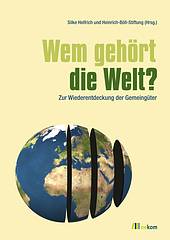
Buchcover: Wem gehört die Welt?Das von Silke Helfrich editierte Buch »Wem gehört die Welt? Zur Wiederentdeckung der Gemeingüter« ist jetzt erschienen. Die Buchvorstellung findet am Montag (23. März) um 19.30 Uhr in der Heinrich-Böll-Stiftung (Schumannstraße 8) in Berlin statt.

Das Buch (PDF) ist, wie mir scheint, sehr imposant geworden, mit Beitragen von Yochai Benkler, David Bollier, Petra Buhr (Netzwerk Freies Wissen), Elinor Ostrom, Richard Stallman, Sunita Narain, Ulrich Steinvorth, Peter Barnes, Oliver Moldenhauer (Ärzte ohne Grenzen), Pat Mooney und vielen anderen. Ein besonderes Anliegen des Buches ist es, die Bewegungen der »geistigen Gemeingüter« (Freie Software, Freies Wissen, Freie Kultur…) und der »natürlichen Gemeingüter« (Umwelt- und Naturschutz, Ernährungssouveränität etc.) in ihren gemeinsamen Perspektiven zu zeigen und miteinander ins Gespräch zu bringen – momentan fehlt es an Kontakten und Anknüpfungspunkten zwischen diesen Bewegungen, obwohl jeweils das eine ohne das andere keinen Sinn ergibt.

(mehr …)

Marx’ Theory of Value and Why Exchange Can Be “Equal” and Still Bad

Karl MarxThis post resulted from a thread on the p2presearch mailing list. The discussion started when a remark by Joseph Jackson’s “forced” me to clear up some frequent misunderstandings about the meaning of the labor theory of value, as formulated by Karl Marx. The thread then turned to Marx’ criticism of capitalism and I tried to explain why (according to Marx) the root cause of raising inequality and other detrimental effects of capitalism isn’t “unequal exchange,” but rather exchange per se, regardless of whether or not it’s equal.

Quotes from Joseph Jackson are indented and printed in italics:

Economics has no coherent Theory of Value and we must solve this problem if we are to establish the field of Abundance. The Labor Theory of Value has advantages in that it is objective and normative—it states that price should tend toward the cost of production; it also allows us to determine what constitutes equitable exchange.

Actually, the Labor Theory of Value, as first formulated by Adam Smith and Ricardo and later refined by Marx, is not normative, but descriptive: it describes the basics of price formation in capitalism. Of course, the value of goods is only their average price—actual prices will usually be somewhat below or above the average because of fluctuations in supply and demand etc.

(mehr …)

Thesen zu Commons und Eigentum

Logo der Wikimedia CommonsRainer Kuhlen (Universität Konstanz), Silke Helfrich (Commonsblog), Christiane Grefe (Die Zeit) und ich haben gemeinsam einige Thesen zu Commons und Eigentum entwickelt, die wir vorgestern auf dem 5. Allmende-Salon zur Diskussion gestellt haben:

  1. Alle Eigentumsregelungen müssen dem Erhalt und der Erweiterung der Commons verpflichtet sein: Das Konzept der Commons (Gemeingüter) beginnt sich als umfassendes Organisations- und Gestaltungsprinzip in Wirtschaft, Politik und Gesellschaft durchzusetzen. Dadurch wird der Begriff des Eigentums nicht überflüssig oder aufgelöst. Aber er wird grundlegend neu ausgerichtet.
  2. (mehr …)

Was sind Commons?

Logo der Wikimedia CommonsUnter dem Stichwort Commons findet sich in der Wikipedia nur eine Disambiguierungsseite, unter Gemeingut gibt es dürre und inhaltlich problematische Informationen, die vor allem auf Kostenlosigkeit abzielen (“Ein Gemeingut oder Kollektivgut ist ein Gut, das für alle potenziellen Nachfrager frei zugänglich ist.”)

Tatsächlich ist es nicht leicht, zu klären oder zu erklären, was Commons (auf Deutsch oft als “Gemeingüter”, manchmal auch als “Allmende” übersetzt) eigentlich sind. Aus dem von Silke Helfrich initiierten Allmende-Salon heraus ist jetzt eine kleine Initiative entstanden, die versuchen will, es trotzdem zu machen und eine griffige Charakteristik des Commonsbegriffs hinzukriegen (oder zumindest eine Textgrundlage, anhand derer man sich dann später besser über die Bedeutung dieses Begriffs streiten kann 😉 ).

(mehr …)

Contraste-Schwerpunkt zur Peer-Ökonomie

Contraste-LogoDie Peer-Ökonomie ist Schwerpunktthema der aktuellen Ausgabe der Contraste, der “überregionalen Monatszeitung für Selbstorganisation”. An dem Schwerpunkt haben neben Benni, Stefan, Thomas (Kalka) und mir auch Silke Helfrich vom Commonsblog sowie Annette Schlemm mitgewirkt; koordiniert wurde das Ganze von Uli Frank (Danke nochmal!).

Wer die Contraste nicht sowieso schon liest, kann sie hier bestellen. Aber wie es sich für die Peer-Ökonomie gehört, stehen alle Schwerpunkt-Artikel unter Copyleft (CC-BY-SA) und sind auch online verfügbar.

Der Schwerpunkt umfasst folgende Artikel:

Gute Lektüre!