Download the poster.
Print it, spread it!
Join the conference!
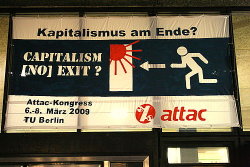
Am letzten Sonntag, 8. März 2009, begaben sich ca. 50 Interessierte auf die »Suche nach dem Neuen im Alten« — so der Titel des Attac-Workshops, zu dem Benni und ich eingeladen hatten. Es wurden kurzweilige 90 Minuten. Der komplette Audio-Mitschnitt ist bei archive.org verfügbar.

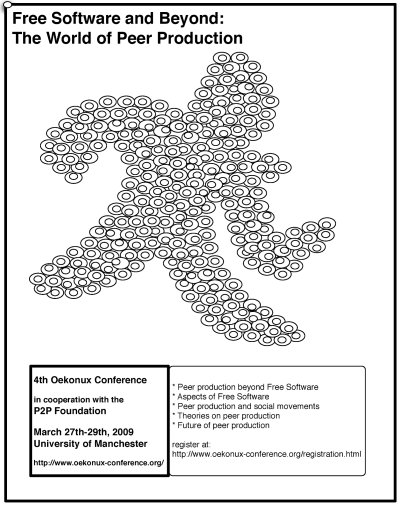
Version 1.0 of the 4th Oekonux Conference program has been released. 26 speakers cover a wide range of topics from immaterial to material peer production and theory to practice. As far as titles of the speeches are given — a very interesting program!
The 4th Oekonux Conference is organized by Oekonux project in cooperation with P2P Foundation and takes place in Manchester (UK) from 27th to 29th of march 2009. Conference organizers ask for registration, which would help to prepare the conference.
DE: Über die GEMA-Aktion von Johannes Kreidler vom September 2008 ist nun ein Doku-Video erschienen. Die Forderungen waren zahm, aber die GEMA blieb dogmatisch. Nur im Kommunikationsstil hat sie sich an der Aktion orientiert: »Tolle Aktion hat eine tolle Diskussion angestoßen«. Und nu?
EN: There was a video documentation released about a protest against GEMA in september 2008 (a german performance rights organization). The demands were tame, but GEMA remains dogmatic. Only concerning the style of communication GEMA oriented at this action: »Great perfomance has initiated a great discussion«. And now?
[via]
A new idea comes to the US — everything for free. This is an art project, and there are nice reactions of the »takers«.
A paragraph of my previous post about an article from Michel Bauwens in we_magazine lead to heavy reactions of Michel, cross-posted here and in Oekonux mailing list. Since some posts only go to the mailing list, I re-publish one of my responses here again. Here we go:
Hi Michel,
I try to answer your questions as best as I can, but I also take the freedom to question your questions, because they base on assumptions I don’t share.
Michel Bauwens from P2P-Foundation recently published an interesting article in the new we_magazine (=>Manifesto) summing up current developments in peer production. After explaining the most important aspects of immaterial peer production he discusses the differences when coming to material production. The first expansion step into the sphere of material production is the opening of the design process.
Nach dem ersten Teil, dem Vortrag von Christian Siefkes, hier nun die aufbereiteten Mitschnitte des Workshops am nachfolgenden Tag. Mit 20 Teilnehmenden war die maximale Workshop-Größe ausgeschöpft. Die Diskussion war inhaltlich sehr kontrovers (»unbarmherzig«), im Ton und dem Aufeinandereingehen dennoch sehr freundlich und konstruktiv (»fortschreitend«). Zum Auftakt trug Uli Weiß eine sehr grundsätzliche Kritik am Modell der Peer-Ökonomie von Christian vor. Leider ist die Aufnahme dieses Teils misslungen 🙁
Daher gibt es nachfolgend nur die Notizvorlage von Uli, die Grundlage seines Beitrags war.
Die sich daran anschließende Diskussion wurde dann aber komplett aufgezeichnet. Ihr findet die drei Teile bei archive.org.
(mehr …)
Free Software and Beyond
The World of Peer Production
4th Oekonux Conference
in cooperation with
P2P Foundation
Invitation
Project Oekonux researches the economical, political and social forms of Free Software and similar forms of production we collectively call peer production. In Project Oekonux, different people with different reasons and different approaches get together to build something new. A lot of participants want to know, whether and if so, how, the peer production can serve as a basis for a new society.
Die Gruppe »Wege aus dem Kapitalismus« Berlin hatte Christian Siefkes eingeladen, sein Konzept einer Peer-Ökonomie zur Diskussion zu stellen. Am Freitag, 13.2., gab es Abendveranstaltung mit einem Vortrag, und am Samstag, 14.2., folgte ein Tagesworkshop, bei dem das Konzept intensiv diskutiert wurde. Wir dokumentieren hier bei keimform.de beide Teile der Veranstaltung. Los geht es mit dem Vortrag von Christian am Freitag abend. Ihr könnt ihn hier als Slidecast (Präsentation plus Audio) ansehen und anhören, oder die Präsentation getrennt nutzen (HTML) und den Vortragsmitschnitt herunterladen (archive.org). Der zweite Teil der Workshop-Diskussion folgt in den nächsten Tagen gibt es hier.