Schlagwort: stigmergie

Beyond Digital Plenty (1)

Building Blocks for Physical Peer Production
Journal of Peer Production[Originally published in Journal of Peer Production, Issue #1: Productive Negation, July 2012.]

Summary

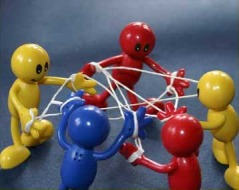
Commons-based peer production has produced astonishing amounts of freely usable and shareable information. While that is amazing in itself, many people think that it is all, arguing that peer production flourishes in the digital realms of the Internet—and only there. This would mean that peer production could never be more than a niche phenomenon, since nobody can survive on information alone. This article challenges the conventional viewpoint, arguing that the potential of peer production extends far beyond the digital sphere into the sphere of physical production and that corresponding developments are already under way.
(mehr …)

The Boom of Commons-Based Peer Production

[Diesen Artikel gibt es auch auf Deutsch.]

[Originally published in The Wealth of the Commons (eds. David Bollier and Silke Helfrich; Levellers Press, Amherst, MA, pp. 289–294). Also available on the website of the book. License: Creative Commons Attribution 3.0.]

In 1991, an undergraduate Finnish computer science student, Linus Torvalds, had a surprising idea: he began to write a new operating system on his PC. His initial goal was to be able to try some things that weren’t possible with the operating systems then available to him. After several months of tinkering, Torvalds noted that he had developed a system that could be useful for others too. He announced his work on the Internet and asked for feedback about features that people would like to see. Some weeks later, he put the software online. Now anybody could download and use his code. It was also possible to adapt it to better fit your needs, if you knew how to program. (mehr …)

Why not just pay someone when needed?

Peers support each otherThis continues the discussion on required vs. facilitated reciprocity that took place on the jox mailing list. Michel Bauwens remained skeptical that stigmergic self-organization is the way to go; he inquired:

what makes you believe that faced with healthcare issues, I will find with certainty a right doctor and equipment willing to take care of me … since I’m facing this kind of issues right now as a peer producer without health insurance, I’d be more than happy to follow your instructions …

As I understand it, his reasoning goes like this: (mehr …)

Required or facilitated reciprocity?

Peers support each otherThe following post is based on two mails I wrote as part of a discussion on the jox mailing list (a relict of the short-lived [DE] CSPP journal) at the end of March. I try to explain why I have changed my position compared to the suggestions formulated in the book From Exchange to Contributions, but also why the change is not as radical as some people seem to think.

While in my book I describe what could be characterized as “open sharing communities requiring reciprocity” (you are required to contribute in order to benefit), my more recent work is about “open sharing communities facilitating reciprocity” – where contributing in some ways is easy and encouraged, but it is not required in order to benefit. When we look at existing successful peer communities, we see that they tend to follow the latter model, hence the change.

(mehr …)

Characteristics of Peer Production

Peers support each otherSummary of the characteristics of peer production, first part using Meretz’s work, the second part from my own studies:

A. The social logics of peer production

It is important to see the value inversion that occurs in peer production. Though it is integrated in the dominant economic model and embedded in the strategies of business firms, there are numerous inversions in the logic of value and production: (mehr …)

The Emergence of Benefit-driven Production

OKCon logoThe following paper was written for the Proceedings of the 6th Annual Open Knowledge Conference (OKCon 2011) which took place about a month before in Berlin. It is also available in PDF format.
Abstract

The free software and free culture movements have radically changed the ways of producing software and knowledge goods. In many cases, participation in such project is benefit-driven rather than profit-driven. Participants get involved in order to realize some practical or social benefit, not because of monetary gains. Another difference from market- and firm-based production is that peer production is non-hierarchical: people voluntarily cooperate as peers; there are no fixed employer/employee or client/contractor relationships. And peer production is based on commons: goods which are jointly developed and maintained by a community and which are shared according to community-defined rules.

Peer production is not just about producing knowledge: Hackerspaces and Fab Labs are the first forerunners of a commons-based production infrastructure. While commons-based peer production reaches beyond capitalism, the preconditions of its development are created by capitalism itself. The paradoxical relationship of capitalism to human labor leads to developments that might make the concept of labor (as we know it today) obsolete, and with it capitalism itself.

(mehr …)

Produzieren ohne Geld und Zwang

¿Otros mundos posibles?[Versión en español]

Dieser Text ist mein Beitrag für die Konferenz „Andere mögliche Welten?“ (¿Otros mundos posibles?), die im Mai in Medellín (Kolumbien) stattfand. Alle Beiträge der Konferenz werden in einem Sammelband der Rosa-Luxemburg-Stiftung erscheinen, der Ende des Jahres in deutscher sowie in spanischer Sprache veröffentlicht werden soll.

Die Bewegung zum Commonismus

Stellen wir uns eine Welt vor, in der Produktion und Reproduktion bedürfnisorientiert zum Wohle aller stattfinden, organisiert von Menschen, die sich niemandem unterordnen müssen und sich freiwillig in die erforderlichen Tätigkeiten teilen. Ich nenne eine solche Gesellschaft Commonismus, weil ich glaube, dass darin die Commons, die Gemeingüter, eine wichtige Rolle spielen werden.

Man mag einwenden, dass eine solche Gesellschaft unmöglich sei, weil es sie noch nicht gab oder weil sie der Natur des Menschen widerspreche. Doch daraus, dass es etwas noch nicht gab, kann man nicht schließen, dass es unmöglich ist; und Argumente zur „Natur des Menschen“ übersehen, dass die Menschen nicht nur die Gesellschaft machen, sondern umgekehrt auch durch die Gesellschaft beeinflusst und geprägt werden. Ändern sich die Strukturen, ändert sich auch das Verhalten der Menschen.

(mehr …)

Eine Welt ohne Geld?

So stellt sich die Oya-Illustratorin die geldlose Produktion vor (zum Vergrößern klicken)Wie gleichberechtigt und freiwillig produziert werden kann

[Der folgende Artikel wurde in der Oya 8 veröffentlicht, deren Thema das „Geldbeben“ ist.]

Das Geld spielt in unserer Gesellschaft eine so große Rolle, dass es schwierig ist, sich eine Welt ohne Geld vorzustellen. Arbeiten die Menschen nicht nur, um Geld zu verdienen?

Würden Firmen ohne die Erwartung von Profiten etwas produzieren? Wahrscheinlich eher nicht. Doch für das Tun der Menschen spielt das Geld keine so große Rolle, wie man gewöhnlich denkt. Weniger als 40 Prozent der in Deutschland geleisteten Arbeiten werden bezahlt, der größere Teil wird nicht entlohnt: Tätigkeiten im Haushalt, private Pflege- und Betreuungsleistungen sowie ehrenamtliche Tätigkeiten. Gerade weil sie unbezahlt sind, werden diese Tätigkeiten in unserer Gesellschaft meist nicht sehr ernst genommen, doch ohne sie würde alles zusammenbrechen. Und sie demonstrieren eindrucksvoll, dass Menschen für andere nützliche Dinge tun, auch wenn sie nicht mit Geld „bestochen“ werden.

(mehr …)

Das gute Leben produzieren

Streifzüge Nr. 51 (zum Vergrößern klicken)[aus: Streifzüge Nr. 51]

Wenn wir über das gute Leben nachdenken, stellen wir uns ein Leben in Fülle vor – wo niemand Not leiden muss, wo es genug für alle gibt und jede/r seine oder ihre Bedürfnisse befriedigen kann. Aber geht das überhaupt? Scheitert die Möglichkeit eines Lebens in Fülle nicht zwangsläufig an der Endlichkeit der Erde? Und wo soll die Fülle herkommen? Kommt nicht vor den Freuden des Konsums die Mühsal des Produzierens, vor dem angenehmen „Reich der Freiheit“ das weniger erfreuliche „Reich der Notwendigkeit“? Um diese zwei Herausforderungen für die Vision eines guten Lebens für alle soll es im Folgenden gehen.

(mehr …)

Peer Produktion: Wie im Internet eine neue Produktionsweise entsteht

Beitragen statt tauschenDer folgende Artikel ist im WIDERSPRUCH – Münchner Zeitschrift für Philosophie, Heft 52 (2010) erschienen.

„Kreativ zu sein, ist eine inhärente Eigenschaft des menschlichen Geistes … Warum singt Figaro, warum schreibt Mozart Musik, die Figaro singt, warum erfinden wir alle neue Worte? Weil wir es können. Homo ludens trifft Homo faber. Die soziale Bedingung globaler Verbundenheit, die wir das Internet nennen, ermöglicht uns allen, kreativ zu sein auf eine neue und nie erträumte Weise. Wenn wir nur nicht das ‚Eigentum‘ dazwischen­funken lassen.“

So beschreibt der US-amerikanische Rechtsprofessor Eben Moglen (1999) das bemerkenswerte Phänomen, das Peer-Produktion genannt wird. Es hat die Art und Weise der Produktion von Software und Kulturgütern in den letzten Jahrzehnten kräftig durcheinander gewirbelt. Was ist das Geheimnis der Peer-Produktion, und wie weit reicht ihr Potential? Warum und unter welchen Umständen kommt es zur spontanen und ungezwungenen Kooperation gleichberechtigter „Peers“? Welche Bereiche der gesellschaftlichen Produktion wurden dadurch schon verändert, und wo stehen Veränderungen ähnlicher Reichweite bevor? Darum soll es im Folgenden gehen.
(mehr …)