Schlagwort: peer-production

Peercommony Reconsidered

ZNet Debates logo[This is part of an debate regarding parecon and peercommony between Michael Albert and me. It is a repy to Michael Albert’s Considering Peercommony. All articles can be found on the debate overview page – more will follow.]

Michael formulates various concerns and objections, many of whom are not new to me. I can’t address all of them fully, for lack of space and because many seem to ask for a blueprint of a future, non-capitalist society, which is not something I can or want to give. The meta-rule of all peer/commons-based institutions is that “you have to find your own rules.” Any successful peer project has a history of trial and error. Finding solutions that work for you is an essential part of the game.

But while I cannot describe the exact institutional mechanisms Michael asks me to describe, I’ll give my reasons why I think that people will be able to find and implement them. (mehr …)

My Doubts About Parecon

ZNet Debates logo[This is part of an debate regarding parecon and peercommony between Michael Albert and me. It is a repy to Michael Albert’s Summarizing Participatory Economics. All articles can be found on the debate overview page – more will follow.]

While I like the goals of the Parecon, one thing that confuses me is that Parecon, while intended to overcome capitalism, still resembles it in an essential aspect. Society still revolves about paid labor: everybody is forced to work for money in order to be able to buy the things they need to live. Why is that so? Do we really must forever force people to work because otherwise they wouldn’t?

A typical proponent of capitalism would probably respond: “Yes, humans are just lazy bastards. Without coercion, nobody would work and humanity would perish.” Michael Albert argues a bit smarter, but essentially in the same way:

If we disconnect work and income, … people will typically choose to work too little for the social good to be optimally met, and people will choose to take too much for the system to even work because the available output will fall well short of available demands for income.

So, everybody it still a bit too lazy and a bit too greedy for society to work without coercion, it seems. But is that claim as self-evident as Albert puts it? Moreover, if the mismatch between “available output” and “available demands” was real, could Parecon avoid it? I doubt both points.

(mehr …)

Die Peer-to-Peer-Ökonomie und eine neue commonsbasierte Zivilisation

[Beitrag aus dem Commons-Buch (Commons – Für eine neue Politik jenseits von Markt und Staat, Hg. Silke Helfrich/Heinrich-Böll-Stiftung); Lizenz: CC BY-SA.]

Michel Bauwens und Franco Iacomella

Die Peer-to-Peer-Vision (P2P) für Wirtschaft und Gesellschaft basiert nicht auf einem utopischen Ideal; sie besteht vielmehr in der Verallgemeinerung jener Formen von Peer-Produktion, Peer-Governance und Peer-Besitz, die derzeit schon im Entstehen sind.1 Die Vision einer neuen Zivilisation und eines neuen Wirtschaftssystems beginnt mit der Analyse der grundlegenden Fehler dessen, was ist. (mehr …)

Widersprüche und Spannungsfelder in der Praxis aktueller Commons-Netzwerke – am Beispiel Freier Software

Titelbild des Hefts 124 der Widersprüche[Diese per E-Mail geführte Diskussion zwischen Annette Schlemm und mir erschien in der Widersprüche, Heft 124 (Juni 2012), S. 25–31.]

Widersprüche-Redaktion (W.R.): Mit dieser E-Mail-Diskussion würden wir gerne einen Beitrag für das nächste Widersprüche-Heft herstellen, der den Leser_innen einen Eindruck von den widersprüchlichen Entwicklungen alternativer Produktionsweisen – am Beispiel der freien Software – ermöglicht. Könnt Ihr eingangs ein paar Hinweise formulieren, wo Eures Erachtens gegenwärtig die entscheidenden Entwicklungstendenzen in dem Bereich der Commons-Netzwerke liegen.

Annette Schlemm (A.S.): In den letzten 10 Jahren hat sich die Erfahrung des Teilens im Gebrauch von Gütern und der selbstorganisierten Arbeitsteilung in vielen Bereichen verbreitet. Das erste Beispiel dafür war die Freie Software. Das Wichtige daran war nicht der technische Code, sondern die sich entwickelnde Praxis vieler Menschen, sich selbstbestimmt zu koordinieren. Bis dahin war häufig angenommen worden, dass eine von Menschen selbst organisierte Arbeitsteilung, die nicht über die „sachliche Vermittlung“ des Geldes bzw. des Kapitals oder planwirtschaftlich organisiert ist, nur als landwirtschaftlich-handwerklich orientiertes Kommune- bzw. Ökodorfnetzwerk möglich sein könnte, aber nicht global und auch nicht auf der Grundlage hochproduktiver moderner Produktionsmittel. (mehr …)

Vortrag »Commonismus«

Hier der erste meiner beiden dicht aufeinander folgenden Vorträge, gehalten am 7.11.2012 in Dresden bei der Rosa-Luxemburg-Stiftung Sachsen (Folien und Ton). Während des Vortrags habe ich zwei kurze Filmchen gezeigt, die ihr in der Audio-Aufzeichnung nur hören könnt. Hier im Blog sind sowohl der Film zu Katja Kippings Aussage über Commons wie auch der Werbefilm über Open Source Ecology in voller Länge zu sehen.

Beyond Digital Plenty (2)

Journal of Peer Production[First part]

Building Blocks for Generalized Peer Production

If we consider at contemporary forms of peer production, we find that the used resources and means of production tend to be commons or distributed widely. For digital peer production, knowledge and information are the most important resources. They are generally treated as commons that everybody can use, share and improve. This philosophy is nicely expressed by the Wikimedia Foundation (2011), the organization running the Wikipedia and related wikis:

Imagine a world in which every single human being can freely share in the sum of all knowledge. That’s our commitment.

Open design (also called open hardware) is the kind of knowledge most important for producing physical things. (mehr …)

Commonismus in Dresden, Bamberg, Hamburg

Hier die beiden nächsten drei Veranstaltungen mit meiner Beteiligung:

Kommunismus oder Commonismus, 7.11.2012, 19:00 Uhr, WIR-AG, Martin-Luther-Straße 21, 01099 Dresden (Veranstalter: RLS Sachsen):

Sind Commons die zeitgemäße Form, die Eigentumsfrage zu stellen und im 21. Jahrhundert zu beantworten? Was ist unter Commons zu verstehen? Ist es nur eine neue Form alte Fragen zu stellen oder geht es mit den Commons tatsächlich auch um einen neuen Inhalt? Müssen sich die Linken auf etwas Neues einlassen oder wissen sie es wie eh und je schon besser? Ist das Commons-Konzept als emanzipatorische Perspektive denkbar, ist es gesellschaftlich verallgemeinerbar? Geht es um Commonismus oder um Kommunismus?

Peer-Produktion – Bastelvergnügen oder Revolution? 8.11.2012, 20:00 Uhr, Balthasar, Bathasargässchen 1, 96049 Bamberg (Veranstalter: Freie Uni Bamberg): (mehr …)

Beyond Digital Plenty (1)

Building Blocks for Physical Peer Production

Journal of Peer Production[Originally published in Journal of Peer Production, Issue #1: Productive Negation, July 2012.]

Summary

Commons-based peer production has produced astonishing amounts of freely usable and shareable information. While that is amazing in itself, many people think that it is all, arguing that peer production flourishes in the digital realms of the Internet—and only there. This would mean that peer production could never be more than a niche phenomenon, since nobody can survive on information alone. This article challenges the conventional viewpoint, arguing that the potential of peer production extends far beyond the digital sphere into the sphere of physical production and that corresponding developments are already under way.

(mehr …)

The Boom of Commons-Based Peer Production

[Diesen Artikel gibt es auch auf Deutsch.]

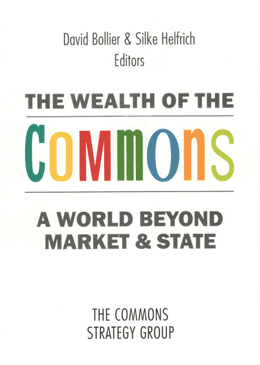
[Originally published in The Wealth of the Commons (eds. David Bollier and Silke Helfrich; Levellers Press, Amherst, MA, pp. 289–294). Also available on the website of the book. License: Creative Commons Attribution 3.0.]

In 1991, an undergraduate Finnish computer science student, Linus Torvalds, had a surprising idea: he began to write a new operating system on his PC. His initial goal was to be able to try some things that weren’t possible with the operating systems then available to him. After several months of tinkering, Torvalds noted that he had developed a system that could be useful for others too. He announced his work on the Internet and asked for feedback about features that people would like to see. Some weeks later, he put the software online. Now anybody could download and use his code. It was also possible to adapt it to better fit your needs, if you knew how to program. (mehr …)

Commonismus

Titelbild ABC der Alternativen 2.0[Dieser kleine Einführungsartikel ist im ABC der Alternativen 2.0 erschienen (Hg. Ulrich Brand, Bettina Lösch, Benjamin Opratko und Stefan Thimmel; VSA, Hamburg 2012, S. 50–51).]

Im Kapitalismus ist das Ziel der Produktion der Profit – Firmen wollen Gewinne machen, InvestorInnen ihr Geld vermehren. Grundlage ist das Privateigentum, das einer Person oder Firma umfassende Nutzungs- und Verwertungsrechte an einer Sache einräumt, inklusive des Rechts, alle anderen von der Nutzung der Sache auszuschließen. Chancen auf volle gesellschaftliche Teilhabe haben die meisten Menschen nur, wenn sie eine Firma überzeugen können, dass diese ihre Arbeitskraft profitabel einsetzen kann.

Dies jedoch ist schwierig, weil man dabei gegen die anderen konkurrieren muss, die dasselbe wollen. (mehr …)