Jahr: 2013

Economics and the Commons?!

Silke Helfrich gave an important introductory talk on the Economics and the Commons Conference (May 22 – 24, 2013, Berlin). The presentation reflects the progress of self-understanding of the commons movement. After some remarks by the moderator Armin Medosch the talk starts around 5:00 showing some commons projects illustrating the variety of the commons. At 21:30 Silke enters the more conceptual part discussing what all the different approaches have in common. The presentation ends at 54:00 and is followed by a discussion. Below, I summarize some of the conceptual statements.

These are some theses Silke developed in her talk (without discussing them here): (mehr …)

Die Commons-Brille aufsetzen

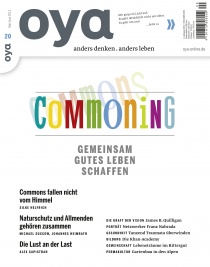
oya-20-2013[Artikel aus Oya 20/2013, Lizenz CC by-sa]

von Birte Friebel

Wie lässt sich Commoning erklären? Die meisten hatten sich vor sieben Tagen erst kennengelernt. Trotzdem steckte vielen beim Abschied von der Commons-Sommerschule ein Kloß im Hals. Eine Woche gemeinsamen Lernens, Wanderns, Singens, Pläneschmiedens hatte eine Gemeinschaft enstehen lassen.

Als Jugendliche habe ich mich nie in einem politischen Umfeld bewegt. Auf eigenen Wunsch bin ich auf eine Privatschule gegangen. Was ich dort vor allem gelernt habe, waren Leistungs­bereitschaft und Marktkonformität. Erst während meines anschließenden Modedesign-Studiums entstanden zwischen Seminaren zum Urheberrechtsschutz und zu grünem Marketing Zweifel. Nach einem Praktikum in Indien war mir klar, dass ich so nicht weitermachen wollte. (mehr …)

Commons im Piraten-Programm

piratenlogoDie PIRATEN haben sich ein Programm für die anstehenden Bundestagswahlen gegeben. Darin findet sich auch ein Abschnitt (im Modul 5: Arbeit und Soziales) zu den Commons. Mal sehn, ob andere Parteien nachziehen. So liest sich der Text:

Commons (Gemeingüter): Vorfahrt für Kooperation, Selbstorganisation und Gemeinsinn

Die Piraten setzen sich dafür ein, Freiräume für Selbstorganisation zu schaffen, Verantwortung zu teilen und Institutionen nachhaltig und erfolgreich zu organisieren.

(mehr …)

Commons: Die Verfassung der Gesellschaft jenseits von Markt und Staat

Ecc2013-logo

Vom 23.-24. Mai findet die Konferenz »Economics and the Commons. From Seed Form to Core Paradigm« in der Heinrich-Böll-Stiftung in Berlin statt. Die internationale Konferenz ist als Einladungsveranstaltung konzipiert und leider nicht allgemein offen. Zur Eröffnung der Konferenz gibt es am 22. Mai 2013 von 16 bis 20:30 Uhr eine öffentliche Veranstaltung mit internationalen Referent*innen (Programm von Konferenz und Eröffnungsveranstaltung hier als PDF, Keynotes der Konferenz auch als Livestream). Programm der und Anmeldung (Eintritt frei) zur Eröffnungsveranstaltung über die Seite der Heinrich-Böll-Stiftung.


Repräsentativsystem und Perspektiven weiterer Demokratisierung

Arbeitskreis Lokale Ökonomie HamburgEin Diskussionsbeitrag aus dem Arbeitskreis Lokale Ökonomie e.V. (AK LÖK), Hamburg

Möglichst viel Demokratie ist allerseits gewünscht. Darauf können sich viele einigen. Bei genauerem Hinsehen nimmt sich eine wirkliche, basisdemokratische Mitwirkung der Menschen an ihrer Gesellschaft bisher freilich eher bescheiden aus. So ist z.B. ein kleiner Teil der Bevölkerung nahezu dauerhaft in einer Sprecherrolle, während es der Großteil schon seit der Kindheit gewohnt ist, dass andere für ihn sprechen und handeln. Gleichzeitig stellt sich für jeden von uns ein alltäglicher gesellschaftlicher Zusammenhang durch eine Vielzahl von Kauf-Verkauf-Handlungen her.1) Das sind Vorgänge, die von Einzelnen kaum praktisch in Frage gestellt werden können, wenn sie nicht verhungern wollen.

Im folgenden soll dargestellt werden, wie die Menschen vielleicht eines Tages ihre eigenen gesellschaftlichen Zusammenhänge intensiver, direkter und weniger stellvertretend bestimmen, also wirklich »mehr Demokratie wagen« könnten. Dazu ist es aber nötig, sich die real erfahrbaren Hindernisse von dauerhafter Selbstorganisation anzusehen, um nach Möglichkeiten ihrer Überwindung zu suchen. (mehr …)

Zum 1. Mai: Film gegen die Arbeitsreligion

In seinem Film »Frohes Schaffen — ein Film zur Senkung der Arbeitsmoral« attaktiert Konstantin Faigle einen heiligen Gral: die Arbeit. Ganz unausgewogen, also mit einer deutlichen Haltung, nimmt er die Absurditäten der verrückten Arbeitsgesellschaft auf’s Korn. Ab morgen in deutschen Kinos. In einer Aspekte-Sendung wurde der Film vorgestellt:

Update: Im Casablanca Nürnberg gibt’s morgen, 2.5.2013, um 19:00 Uhr eine Premierenvorführung mit anschließender Podiumsdiskussion.

Internet Movement and Cybernetic Subversion

[Part 5 of 5 of the essay »Anti-economics and Anti-politics« by Robert Kurz, published under CC by-nc-sa]

One would have to be pretty naïve to assume that a new social movement, under the impact of the crisis, would immediately commence with a radical critique of the commodity production system. It is, rather, more likely that such a perspective can only be mediated by a public debate and by conceptual discussions in the midst of the social struggles and conflicts themselves. One does not start from zero, however. In societies in crisis, there are diverse initiatives for a “cheap economy” which, however, are still in the infant stage. These hardly do justice to a kind of reproduction “that transcends the market and the State”, since in most cases they rely on State (municipal) subsidies or else are restricted to creating enterprises based on the most basic developmental forms of the market and the State.

(mehr …)

Disconnection from Commodity Production

[Part 4 of 5 of the essay »Anti-economics and Anti-politics« by Robert Kurz, published under CC by-nc-sa]

So how is a “natural microelectronic economy” possible as an embryonic form? The difficulty consists in the fact that the capitalist form of the functional division of society, as in the case of the capitalist structure of use value, cannot be assimilated, without alterations, into an emancipatory reproduction. The personnel of an enterprise which, for example, produces ships, cannot emancipate themselves, such as they are, from the social form of value. Since they do not consume the ships and cannot satisfy their own needs with the means of production of their enterprise, and since, at the same time, the specific production of their enterprise is incorporated into a capitalist system of division of labor, they remain dependent on the production of commodities, with all the familiar social consequences.

(mehr …)

The Supersession of Private Property in the Means of Production

[Part 3 of 5 of the essay »Anti-economics and Anti-politics« by Robert Kurz, published under CC by-nc-sa]

The modified or “superseded” notion of the productive forces and its connection to the relations of production is obviously the precondition for solving the real problem: the supersession of the form of fetishistic value in social relations. On this point it is also necessary, first of all, to bridge the gap between the reductive conceptions, immanent to the system, of the Marxism of the workers movement and that of the alternative movement or the cooperatives. As in the question of the productive forces, we see these movements evincing a speculative and complementary attachment to fetishistic structures. Both political Marxism and the alternative movement reduce their goal to a critique and a supersession of private property in the means of production, although in different ways. When, however, one speaks of the institution, “private property”, it is clear that one is dealing with a moment of the commodity production system, i.e., of its juridical form. It is thus clear that this moment cannot be overcome alone, without overcoming the other moments of the value form and even the latter itself as such. The attempt to eliminate private property in the means of production and at the same time to maintain the forms of mediation of the commodity and money, can only lead to social paradoxes.

(mehr …)
The Concept of the Productive Forces and the Microelectronic Revolution

[Part 2 of 5 of the essay »Anti-economics and Anti-politics« by Robert Kurz, published under CC by-nc-sa]

If we are not to allow ourselves to be confused by the past, we have to attempt to elaborate socioeconomic definitions of an embryonic form, beyond commodity production, at the current level of socialization, without falling into a vulgar practicality. It is thus not by any means a matter of direct plans of action (which can only be developed, furthermore, within the context of a social movement), but of theoretical and practical reflections to concretize the critique of value. The question of the embryonic form of a reproduction no longer mediated by monetary and commercial relations has to be approached historically, analytically and theoretically.

(mehr …)